
6 October 2026
Facing the heat to hunt waterbuck
Hunting a waterbuck in dense bushveld is a challenge. Hunting it at the hottest time of the year verges on madness – BY NICO KOTZE
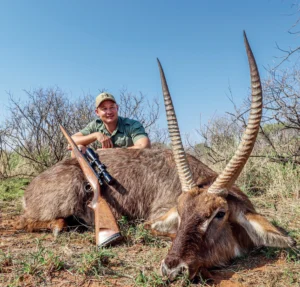
Sweet success – my magnificent waterbuck bull.
I was admiring a fiery Bushveld sunset while listening to the sound of a million geckos, barking in anticipation of the cool night after a scorching day. “Kek-kek-kek,” they continued as the glimmer on the horizon gradually faded into darkness.
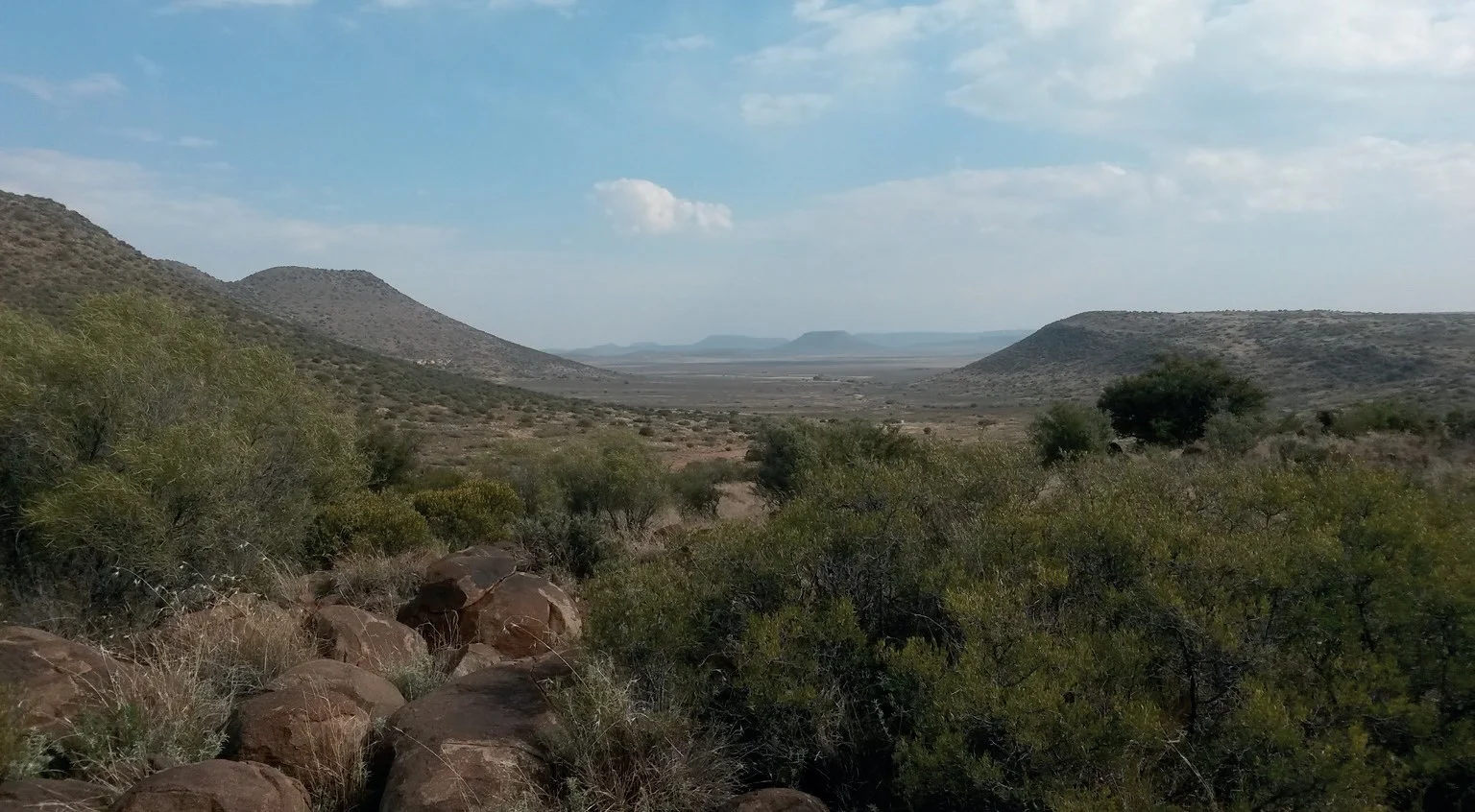
I was invited to hunt a waterbuck bull and cull a few waterbuck cows and some wildebeest in the Steenbokpan/Stockpoort area of the northwestern parts of Limpopo. My friend Casper joined me on the hunt. It was October, the hottest, driest month in this region and probably the worst time to hunt. Temperatures soared above 45 ˚C in the shade and the occasional breeze burnt your skin at midday. This is a time when only the strongest animals survive but still lose condition, a time when the deafening sound of cicadas fills the air, and all animals await the first rains and new life with eager anticipation.
WATERBUCK MEAT – FIT FOR THE MENU OR NOT?
The waterbuck has a reputation for its unpalatable meat. The glands in its skin (mainly in the flanks) secrete an oily substance with an unpleasant, musky smell and taste that sticks to the hair. This forms a waterproof layer around the hair and protects the skin when the animal flees into the water for safety when pursued by a predator.
The same substance is supposedly secreted when the animal is in rut, and possibly also when in distress. It has been reported that some predators avoid preying on waterbuck because of the unpleasant smell. Whether this is true, I don’t know, but I found a bull killed by another one a few months back, and no predators touched the carcass, even though it was surrounded by hyena and jackal tracks.
Over the years, we have learned to love waterbuck meat, provided you know how to carefully dress the animal, firstly removing the legs and avoiding the hair from touching the meat. For me, waterbuck is one of the tastiest types of venison you can find, as long as it has been skinned properly.
Several years ago, I harvested some game and sold the processed meat at different markets throughout Gauteng. I would sometimes prepare fillets of different antelope species and offer customers a small bite to sample without them knowing which was which. About 80% chose the waterbuck meat.
FIGHT TO THE DEATH
Waterbuck bulls have a reputation for aggressively defending their territories, even to the death. They are notorious for killing each other in a stand-off. Although large bachelor herds are formed, a lethal fight often ensues when a satellite bull enters the territory of a dominant bull. Over the years, we have seen so many of these bulls either killed or severely wounded during fights with adversaries.
While hunting warthog in sandy veld one afternoon, I removed my shoes and followed a boar’s tracks. Moving silently through some thicker savanna vegetation, I heard the gallop of a sizeable antelope nearby. Freezing in my tracks, I just listened. Then I heard a hissing sound following the galloping.
On closer inspection, I saw a waterbuck bull run past me, hardly 10 metres away. He had severe abdominal and thoracic wounds and was closely followed by another bull. Even though he had lost the fight, his opponent still pursued him. I listened to them circling each other for another ten minutes. Later, we found the wounded bull dead close to where I had last seen them.
With that being said, I tend to agree with Ruark on the rugged handsomeness of the waterbuck, in addition to its strong fighting and survival spirit. Although it can be a little sedentary by nature, it makes for a challenging hunt once it knows it is being pursued.
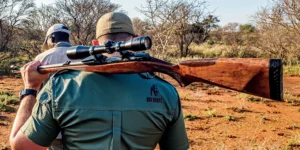
Tracking the wounded waterbuck bull.
THE HUNT
On the first morning, we were in the bush at dawn, already battling the heat. Soon we discovered the fresh tracks of a wildebeest herd. After testing the wind and estimating the direction of the sun, comparing it with the direction the wildebeest had taken, we began following them. We only had a short window of opportunity to harvest one before it would become unbearably hot.
As a crested francolin abruptly broke the silence nearby, my guide Petrus told me there was a stretch of thickets close to where the wildebeest were heading. We assumed they were moving towards the thickets to bed down in the midday heat. Carefully, we continued on their tracks, stopping every so often to listen and scan the surroundings. The wind started swirling, so we decided to circle the place where we thought they might bed down, and then stalk them when the wind was in our favour.
BUFFALO TROUBLE
An hour later, we were stalking downwind towards the thickets. Slowly approaching the dense vaalboom (silver cluster-leaf) and combretum cluster, we heard a grunt, which instantly froze us in our tracks. It wasn’t wildebeest but buffalo!
For some reason, these wildebeest were incredibly skittish. To make matters worse, they have now joined up with a herd of buffalo, which gave them more eyes and ears. We sat down, scrutinising the thickets a mere 50 metres ahead of us. Only the occasional movement of a tail flicking or a head shaking to chase off an oxpecker gave away their presence. We couldn’t distinguish between head or tail but could only make out a black mass hiding in the thickets. They were probably already aware of our presence.
All of a sudden, the buffalo and wildebeest thundered off, breaking bushes as they fled.
Late morning, it was already sweltering hot – the sound of cicadas indicated that the temperature had probably risen to above 40 ˚C. After driving around for a while, searching for fresh wildebeest and waterbuck activity, the Land Rover unexpectedly broke down. Failing to get it running again, we decided to hike back to camp to rest during the midday heat before resuming the hunt in the afternoon.
Four o’clock that afternoon, we were exploring on foot in an area where Petrus had often spotted solitary waterbuck bulls before. The dry heat was intense and almost unbearable, even this late in the afternoon. Nonetheless, we slowly continued, walking upwind.
Passing a herd of roan antelope, we stopped and enjoyed watching a bull chew on an old bone to supplement his calcium and phosphorus levels. A few hundred metres further, we heard a loud snort. Immediately, we took cover behind a blue thorn, scanning the surroundings ahead.
Then the unmistakable gallop of zebra about 60 metres to our right drew our attention as they ran off. Camouflaged by their black and white stripes, we hadn’t noticed them standing in the dense blue thorns. Their thundering hooves spooked everything in the vicinity.
Around six o’clock, the heat was still fierce. At sunset, we stopped and listened to what sounded like a million barking geckos, each male claiming his own piece of territory. The combination of the barking lizards, the heat and the mesmerising sunset made for a nostalgic ambience, taking me back to my childhood days when growing up in the Bushveld. “What a tranquil sight,” I thought – a fitting end to a hot hunting day in the Bushveld.
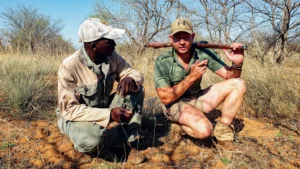
My guide Petrus and I, discussing our options after the wildebeest had joined a buffalo herd.
SUCCESS AT LAST
Early the next morning, we returned to the same area to resume where we had left off the previous day. The sun had just peeped through some thorn trees when we saw a waterbuck bull that would almost certainly qualify as a trophy. Unfortunately, he spotted us at the same time and ran straight into the rising sun.
Cautiously, we followed his tracks. It was slow going as the hard soil made tracking difficult. When he took off running, tracking became a little easier as his hooves left V-shaped prints. However, every now and then, he would stop and carefully walk in a zigzag pattern through the thorn trees, making it almost impossible to follow him.
Mid-morning, we were still pursuing the waterbuck bull. He circled several times. We were tracking upwind again when I spotted a wildebeest bull walking straight towards us through the thorns, followed by his herd. They were unaware of our presence.
Slowly, I moved into a shooting position, waiting for him as he approached us, his head swaying rhythmically. Then he turned slightly, meaning he would pass a few metres to our right. There was an opening about 10 metres to our right where the wildebeest herd would pass, and I decided to take the shot as he entered this clearing.
The moment he appeared in the opening, I softly whistled to make him stop. Instead, he took off frantically, followed by the herd that passed to our right and left. They had no idea where we were, almost running into us. With this commotion, it was pointless to continue tracking the waterbuck bull.
It was already very hot, and we decided to turn back, circling the way we came. Not walking slowly or cautiously, Petrus suddenly stopped and pointed to our right. There he was, grazing in the thorn thickets… He was completely unaware of us and extremely relaxed, probably thinking he had shaken us off.
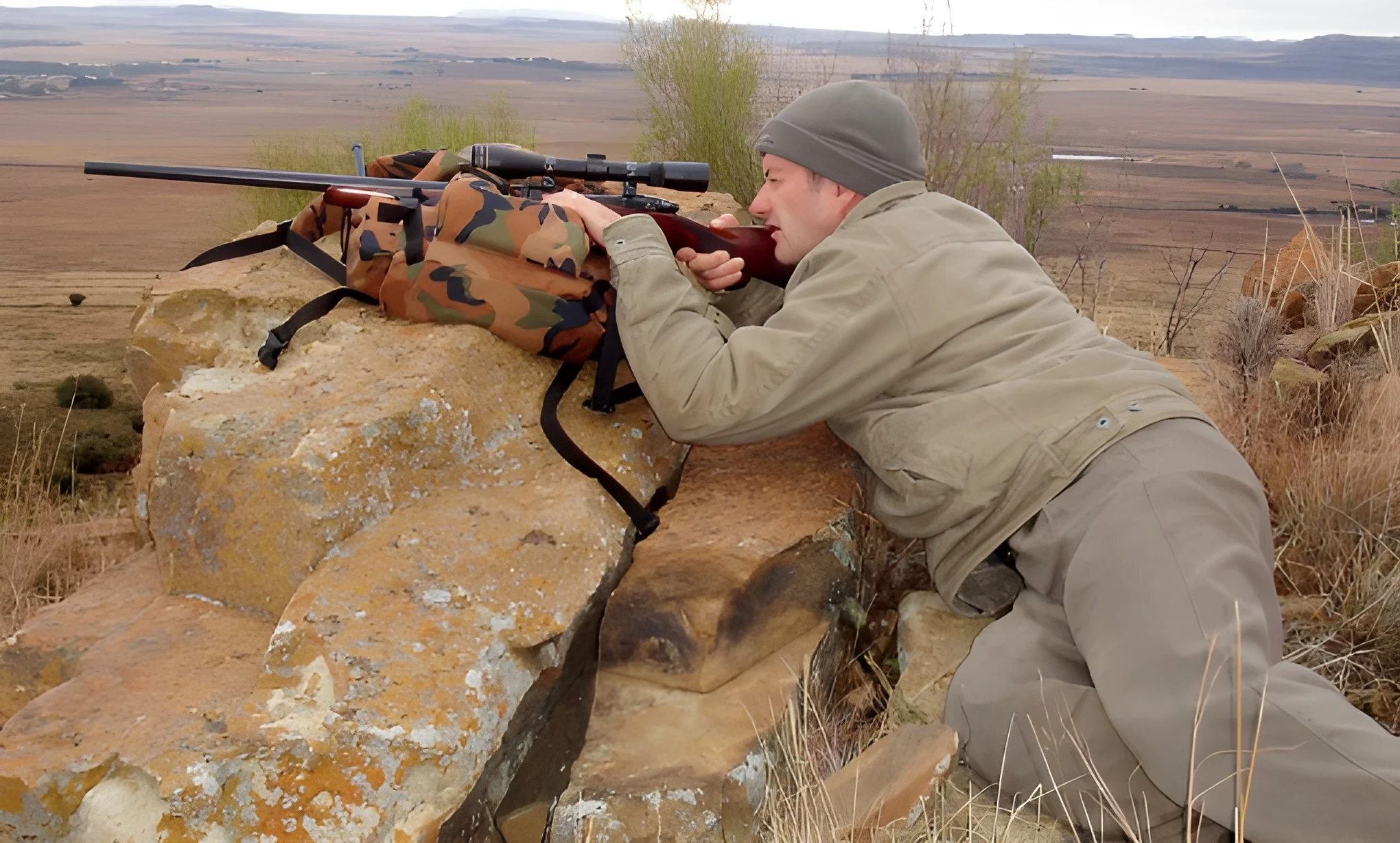
Kneeling, I watched the waterbuck bull through my scope, waiting for a clearing to take a shot. He was only 20 metres away, standing broadside and grazing to our left. The instant a shot at his vitals presented itself, I slowly squeezed the trigger.
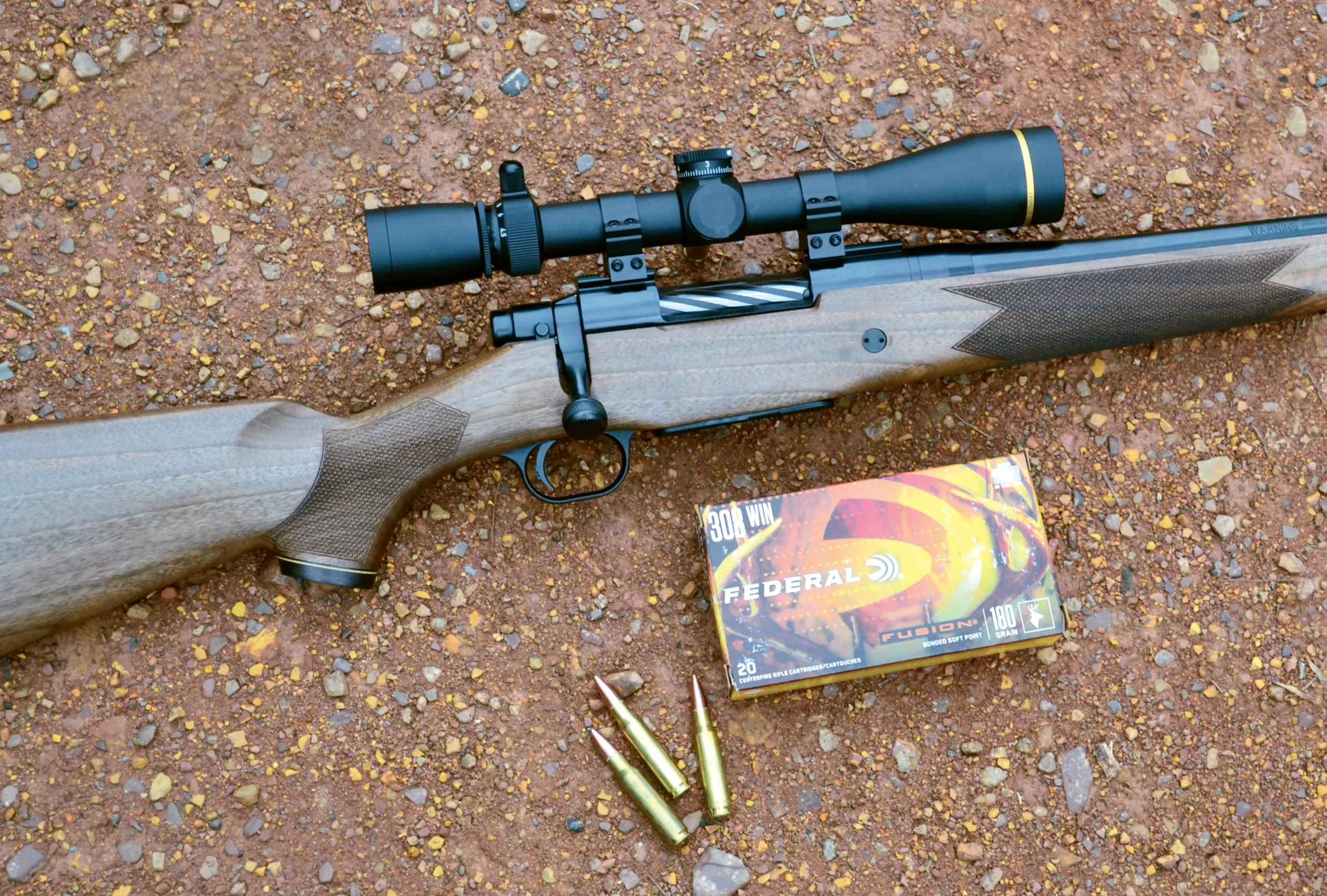
The way in which he took off assured me of my shot. Confidently, I turned around and said, “It’s a heart shot; he will probably only run a hundred metres.” I was hunting with my old, trusty .30-06 with 180-grain bullets, and from experience, I knew he would not go far.
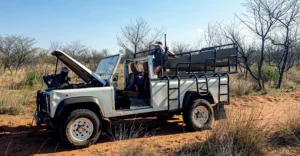
This Landy is going nowhere!
WOUNDED BULL
However, when we examined the waterbuck bull’s blood trail, we found gastric juice. Utterly disappointed, I stared at it in disbelief. How could I have missed his vitals? He was so close! Maybe I hit a branch and the projectile ricocheted a little to the right, or maybe I just pulled the shot.
Dismayed, I looked at Petrus and Casper and said, “I’ve messed up!” To make matters worse, it was already blistering hot, with the mercury touching on 40 ˚C. To track a wounded waterbuck bull in this heat on hard soil was the worst possible scenario, I thought to myself.
We knew time was of the essence and immediately started tracking the wounded bull. After 100 metres, he was still running, confirming my worst fears. After following him for about half an hour, he suddenly broke from the bush 60 metres in front of us, running away. I quickly took a shot and hit his spine, dropping him on the spot.
As we dressed him, it turned out that the first shot went through the heart and somehow deflected, puncturing his stomach. Even though it was a heart shot, he did not go down straight away. This magnificent bull had horn measurements of 28½”. It was a tough hunt but well worth the effort.
(This article was published in the March-April edition of SA JAGTER/HUNTER.)