





One of the most colourful characters to emerge from the old Rhodesia was that country’s one-time Minister of Defence, Foreign Affairs and Propaganda, PK van der Byl. – BY JOHAN VAN WYK
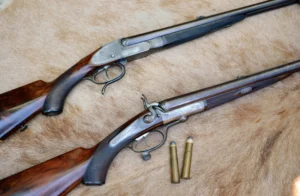
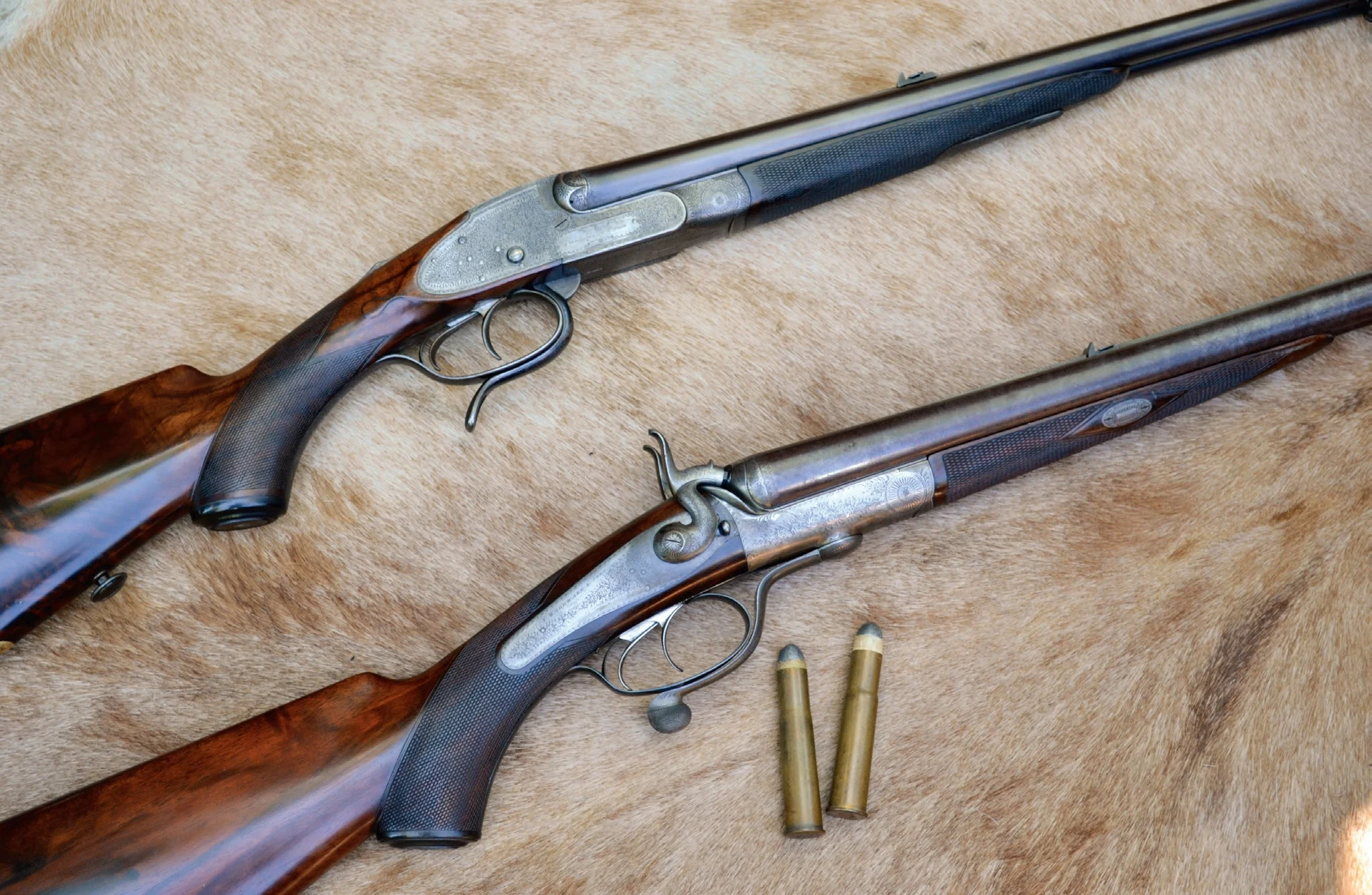
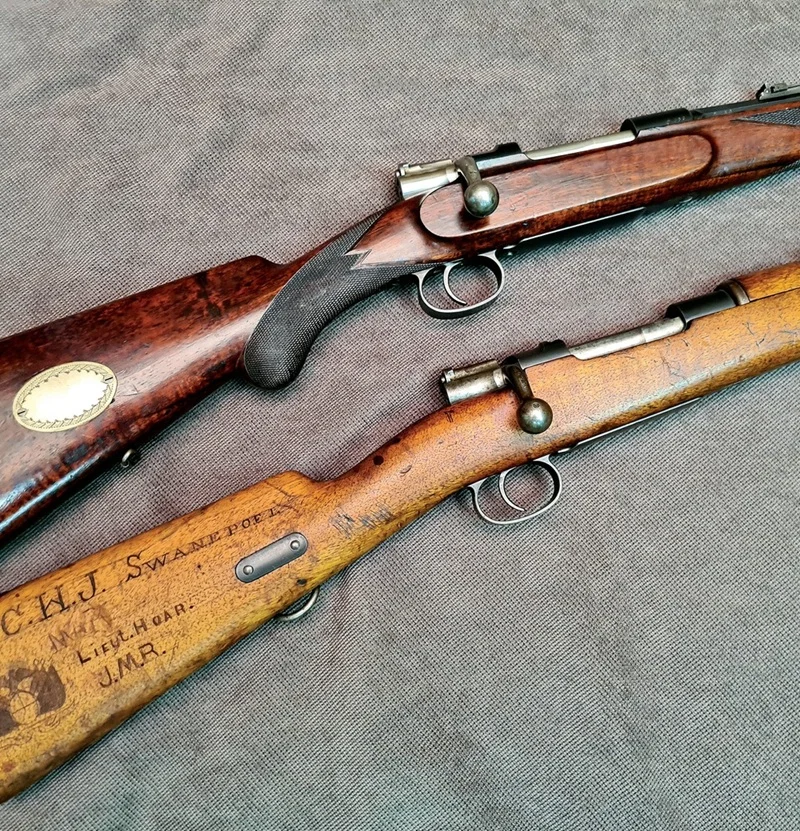
PK van der Byl’s .450/400 BPE double rifle (top) shown with an earlier Woodward hammer rifle chambered for the .577/500 BPE cartridge.
PK (short for Pieter Kenyon Fleming-Voltelyn) was the son of a South African politician and a Scottish mother and was born and raised in the Cape. He served in a cavalry regiment in the British Army during World War II, seeing active service in the Middle East and Italy, and moved to what was then Southern Rhodesia in 1950 to look after his family’s farming interests.
He drifted into politics in the early 1960s and was promoted to the Rhodesian Cabinet in 1968 as Minister of Propaganda. In later years he would simultaneously hold the portfolios of Foreign Affairs and Defence.
Farming and politics notwithstanding, one of PK’s other pursuits was big-game hunting and the Africa of the time offered ample opportunity in this regard. He had an eye for fine rifles as well, and amongst others owned a very rare (only two dozen or so were ever made) original .500 Jeffery bolt-action. Another of his rifles is just as interesting though, and as it is residing in the collection of a friend, I am lucky enough to have access to it.
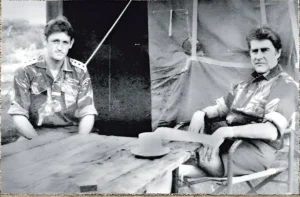
PK van der Byl (on the right) when he was the Rhodesian Minister of Defence at the height of that country’s Bush War.
THE FINEST SIDE-BY-SIDE GUNS
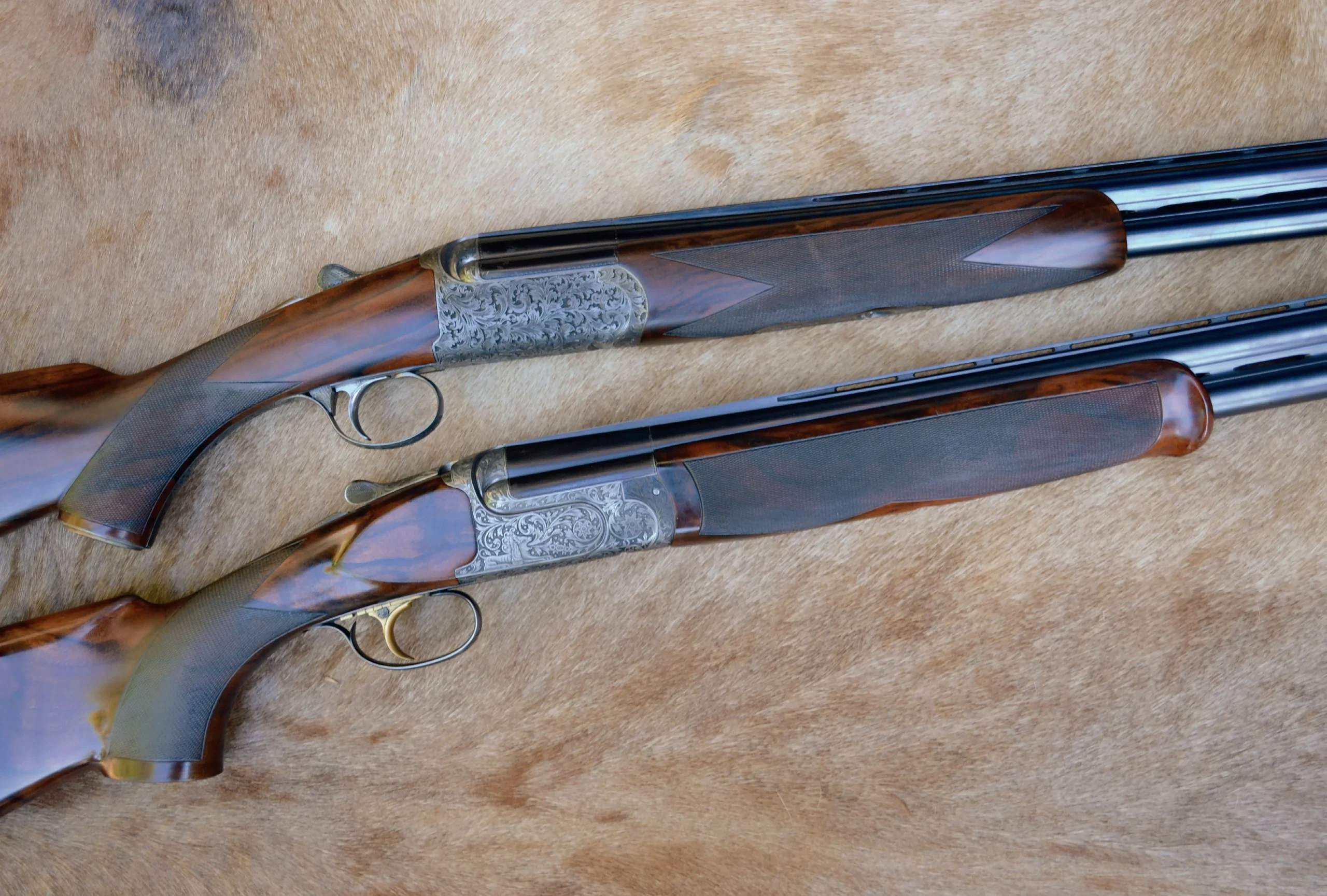
James Woodward & Sons is perhaps best known for the groundbreaking over/under shotgun they introduced in 1913. The Woodward o/u, along with the Boss o/u that came along slightly earlier in 1910, are icons and second-hand examples in good condition are amongst the most prized items collectors can wish for. Before and after the o/u came along though, Woodward made some of the finest side-by-side guns and rifles ever crafted and during their heyday they were ranked right up there with the best makers of the time such as Holland & Holland and Purdey.
Woodward was, first and foremost, a maker of fine shotguns and their guns had a few characteristic features. They were fond of fitting their guns with 29-inch barrels and they developed a grip design named after the then-Prince of Wales that adorns many of their guns.
A Prince of Wales grip resembles a pistol grip but is more open (and thus better suited for use with double triggers) and ends in a flat surface, often adorned with a neat cap of horn or contrasting wood. Also, Woodward adorned their guns with their own style of engraving with characteristic arcaded fences and open scrolls, and they have extended tumbler pivots that stick out on either side of the side-lock action. As such, Woodward guns are usually instantly recognisable.
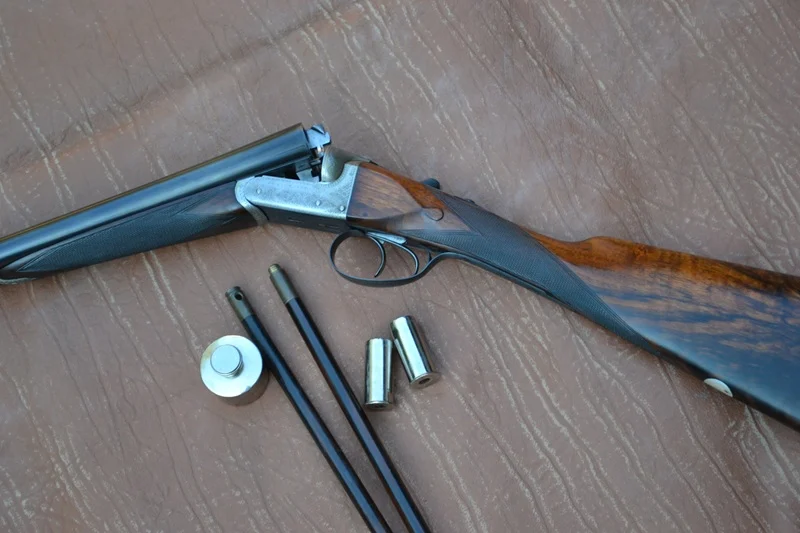
Some years ago, I was fortunate enough to stumble upon a Woodward 12-bore snap-action under-lever, side-lock gun. It was stocked with a straight grip but had 29-inch barrels and was in beautiful condition, considering its age (it was made in 1887 as the No 2 gun of a pair for an English nobleman). It was a lovely gun to shoot but alas, circumstances intervened, and I was forced to get rid of it. I don’t really lose sleep over any of the guns I’ve bought and sold over the years, but I think of that lovely old Woodward a lot. It was by far the nicest gun I have ever owned.
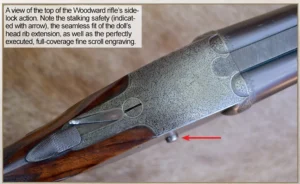
PK van der Byl was a Woodward man and his rifle is, like every other Woodward I’ve ever seen, a fantastic piece of gunmaking. It dates from 1896 and is chambered for the .450/400 (3¼”) Black Powder Express cartridge, a popular chambering of the time and one that was regarded as a good choice for all-round use on lighter game. Rumour has it that PK didn’t bother with sourcing the correct low-pressure black powder stuff but simply used smokeless Kynoch ammunition, loaded with 400gr jacketed bullets and 60gr of cordite.
Since the .450/400 (3¼”) BPE is dimensionally almost identical to the later cordite-powered version of the cartridge, the rifle would certainly have gone bang if the trigger was pulled with the hotter Nitro ammunition in the chambers.
Kynoch ammunition was available in Rhodesia in earlier days and PK would undoubtedly have endeavoured to get hold of a supply in order to shoot his Woodward, so there is a distinct possibility that the old rifle saw its fair share of dangerous-game hunting, notwithstanding its black powder heritage.
It says a lot that the Woodward coped with the higher chamber pressures as well as the harder jacketed bullets the barrels were subjected to. The barrels are still as tight on the face as the day the rifle left the factory with no evidence of overstressed rifling whatsoever.
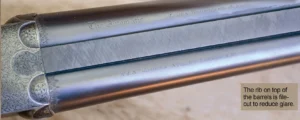
Just like my much-lamented 12-bore, PK’s Woodward is made around a snap-action side-lock action. It is a non-ejector and the action is scaled for the .450/400 cartridge. At first, it appears almost too dainty to accept such a hefty cartridge; the barrels were filed down to a very slim profile, and the rifle looks more like a .303 or other similar small-calibre double than a .450/400 of sorts.
The overall weight of the rifle is under nine pounds, so recoil with full Nitro loads must have been rather sprightly. With low-pressure Nitro-for-black loads that duplicate original ballistics, however, it is a pleasure to fire.
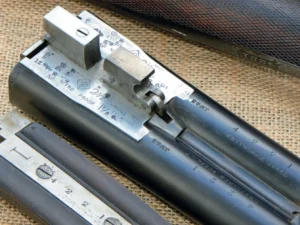
Woodward guns and rifles were renowned for being smooth to open and close. This was due to a small roller-bearing fitted in the lump of the barrels that acted on the hinge-pin of the action.
The Woodward is fitted with 28-inch fluid-steel barrels and it has typical British express-type sights – an open V at the back and several leaves for different distances, and a tiny brass bead at the front. The proof marks reveal that it was originally regulated for a 230gr bullet and a charge of 110gr of black powder. This partially explains the relatively light weight of the rifle. The other half of the explanation is that Woodward simply made the rifle as light and as well-balanced as possible to show off their skills as a premier London gunmaker.
The lock-plates feature the usual Woodward-style open scroll engraving and extended tumbler pivots, and the fences are arcaded. As fine as this is, however, the engraving on the action body itself is what really sets the rifle apart.
One often reads of descriptions such as “full-coverage scroll” and the like in connection with best-quality guns and rifles, but whoever engraved this rifle certainly took this description to heart as the whole of the action body is engraved in the finest, most perfectly-executed fine scroll engraving imaginable. Because the action has a snap under-lever the top of the action and the tang provided an extensive canvas for the engraver to do his magic.
Woodward was known for the outstanding wood they stocked their guns with, and rumour has it that they had first pick whenever the French walnut merchants from across the English Channel showed up. I haven’t seen hundreds of Woodward guns and rifles (just about nobody has!) but the ones I have seen were all stocked with the finest French walnut.
Wood of the type that is today just about unobtainable at any price. PK’s Woodward is no exception. The right-handed butt stock has a graceful cheekpiece and the pistol grip is finished with a steel trapdoor, grip cap for a spare front sight. The elegant splinter fore-end is firmly held in place by means of a quarter-turn lever release, also elegantly engraved.
QUALITY IN THE SMALLEST DETAILS
When turning to the small details, the Woodward has all of those normally associated with best-quality double rifles. It is cased in an oak-and-leather case with all the period accessories still in place. It is also fitted with an additional stalking safety to keep the normal sliding thumb safety on top of the tang from being disengaged, either accidentally or by a disgruntled gunbearer. The characteristic extended tumbler pivots are engraved with a fine gold line on either side and they simultaneously serve as cocking indicators. To aid in smooth closing, a roller pin is fitted to the rear lump under the barrels, and indeed, the Woodward’s action closes with a minimum of effort. Details, the devil is in the details!
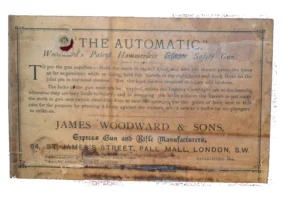
As Woodward were primarily makers of shotguns, Woodward rifles of almost any description are very rare. The only Woodward double rifles I have encountered have been chambered for small-bore cartridges such as the .303 or for black powder cartridges like PK’s rifle, but they made the odd large bore Nitro-Express rifle as well as they were in business right through the era between the wars until after World War II when such rifles were in high demand. Encountering such a rifle today in good condition would be a coup of some note in terms of the used-gun market, and I would love to spend an afternoon or so going through the Woodward records to ascertain for myself exactly what they were up to all those years ago.
CUTTING THEIR LOSSES
As fine a gunmaker as Woodward was, they did not survive World War II unscathed. Their premises in Bury Street were badly damaged by bombs and they had to take up temporary lodging with Joseph Lang, further down the same street. After the war, with austerity measures firmly in place, Woodward was faced with a shrinking client list and production was down to three guns per year. It was clearly time to take stock of things and cut losses.
Charles Woodward, grandson of the founder, took matters in own hand and offered his family business for sale to Tom Purdey in September 1948. Purdey initially declined the offer but after rethinking matters, relented and bought Woodward’s as a going concern for £300, as well as an additional £144 and some small change for materials, parts, and work in progress. After making just over 5 000 guns, James Woodward & Sons was no more.
What clinched the deal with Purdey wasn’t Woodward’s sterling reputation or small but highly skilled workforce, it was the Woodward o/u. Purdey had tried their hand at making an elegant o/u gun since the 1920s but their designs were invariably clumsy and too heavy and did not find fancy with their clients. At the time Tom Purdey went on annual marketing trips to the United States because he knew that demand for o/u guns across the Atlantic was strong.
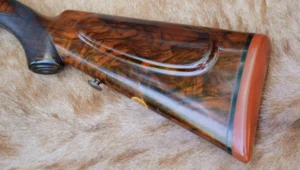
PK’s Woodward double rifle was stocked with the type of French walnut that is today almost unobtainable, no matter the price. Note the gracefully shaped cheekpiece.
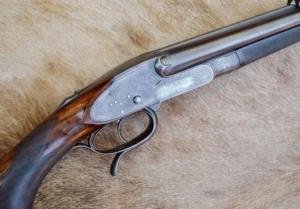
A view of the side of the action shows the extended tumbler pivots that also served as cocking indicators as well as the arcaded fences of the action. Both were Woodward characteristics.
The Woodward o/u was sublime and with the acquisition of James Woodward & Sons, Purdey had an opportunity to adopt one of the finest o/u guns on the market as their own. Purdey immediately started production of Woodward-design guns and very quietly discontinued all of Woodward’s other designs. With a few changes, the modern Purdey o/u is for all practical reasons the Woodward o/u of 1913. The first Woodward/Purdey o/u was delivered in 1950 and production continues to this day.
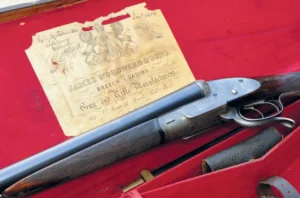
Johan’s long-lost Woodward 12-bore side-lock shotgun mentioned in the article.
The Woodward records remain intact and is today in the possession of Purdey. In 1995, Purdey announced that it would once again offer both o/u and side-by-side guns bearing the Woodward name, so it is once more possible to own a Woodward… if your budget allows.
The PK van der Byl Woodward was bought from his estate after his death in 1999 by the late Bruce Highman. Bruce, however, did not keep the rifle for long and sold it to Pretoria collector Andrew Tonkin, in whose collection it still has pride of place. Geoff McDonald, proprietor of Woodleigh Bullets in Australia, made a special batch of 230gr jacketed soft-nose bullets for PK’s old Woodward and it is once again ready for action in Africa.
(This article was published in the February 2020 edition of SA JAGTER/HUNTER)
ALSO READ