



21 October 2026
An elephant called Satani: A 20-year hunt
Well-known game warden RON THOMSON recounts his 20-year pursuit of Satani, a rogue elephant responsible for several deaths in Zimbabwe’s Hwange National Park.
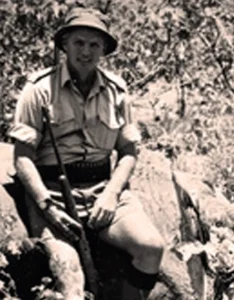
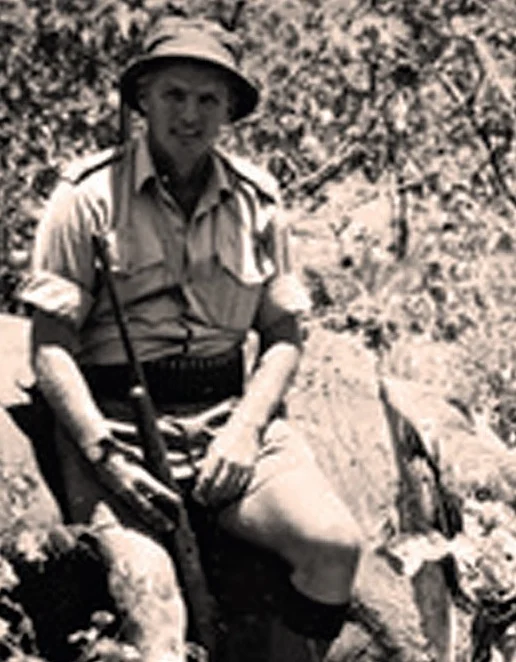
During his many years of service as a game warden, Ron Thomson had to deal with hundreds of problem elephants.
I first crossed swords with Satani in March 1962. He was raiding village crops in the Tjolotjo teak forest of Western Matabeleland, Rhodesia (now Zimbabwe).
March was getting on towards the end of the rainy season, and that was when the village crops ripened. That was also when the elephant bulls of Hwange National Park vacated the game reserve and moved into the teak forest in large numbers.
They did not move en masse, but infiltrated in ones and twos and in threes and fours to take advantage of the ripening crops that surrounded the many villages that were springing up everywhere throughout the forest. And the elephants stayed until the crops had been reaped.
That was the busiest time of the year for me because it was one of my annual duties to hunt down and shoot crop-raiding elephants and buffaloes.
ROAMING ELEPHANTS
The elephants did not stay in one place. They wandered everywhere, moving from one sinanga thicket to another. And when I say those sinangas were thick, I mean they were thick!
Game warden Bruce Austen, the officer in charge of Hwange National Park in those days, received a telephone call one morning from the district commissioner at Tjolotjo who advised him that an elephant crop raider had killed the sabooku (headman) of the Gwabazibwuya village line during the night.
Apparently, he had gone out onto his farmlands unarmed to drive off a single marauder and got himself killed. Bruce tasked me with the job of responding to the district commissioner’s request for assistance. I was then just 23 years old.
GEARING UP FOR THE HUNT
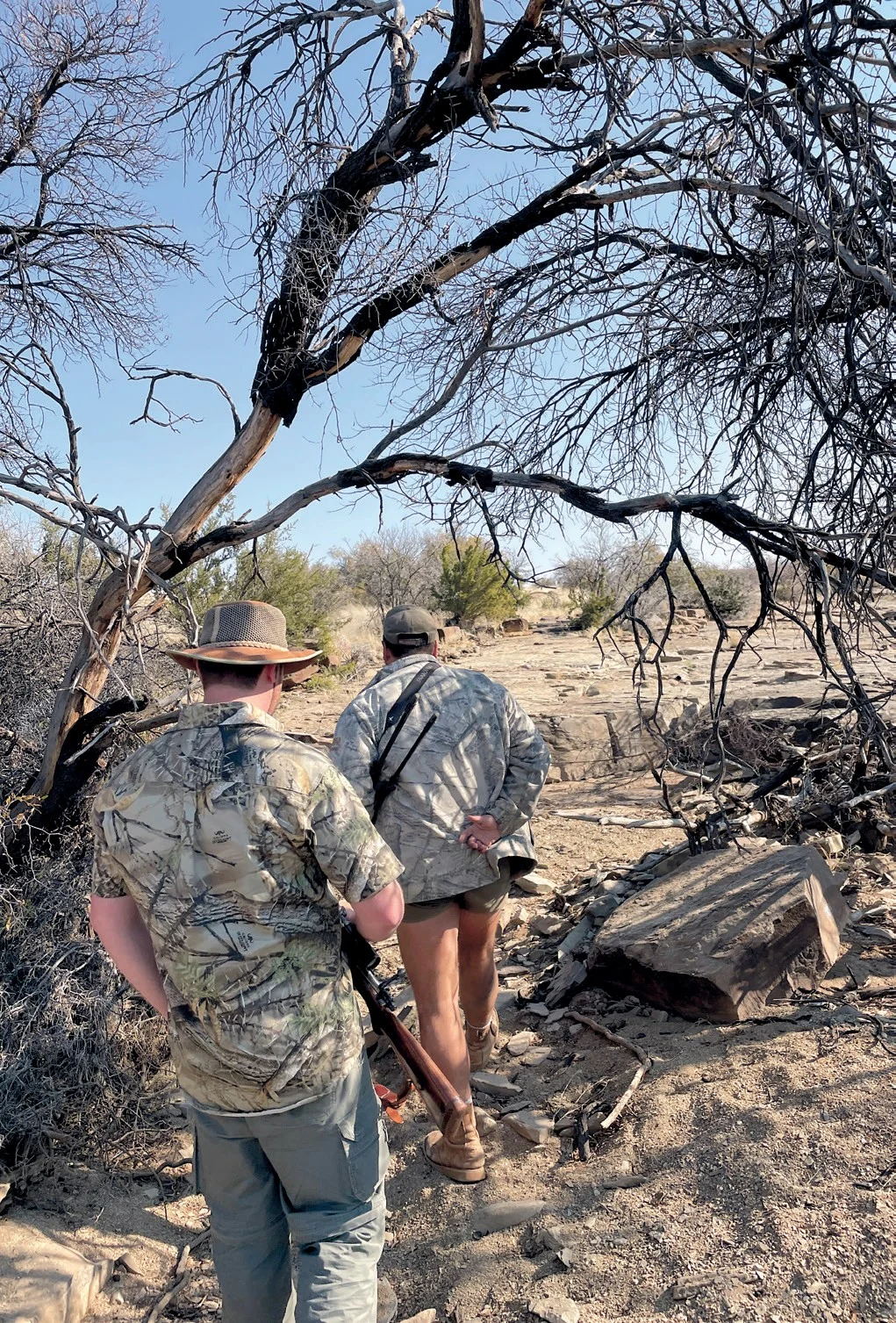
Equipped with camping gear, food and fuel for a week, I travelled down to Ngamo along the railway line fireguard track in a government Land Rover. I was accompanied by two experienced uMsili Bushman trackers. From Ngamo, we followed some very vague scotch-cart tracks down to the Gwabazibwuya village line.
The roads were just old wheel tracks, so we ploughed through the Kalahari sand in low-range, four-wheel drive. It was midday by the time we reached the village. The sabooku’s eldest son, Samuel, was awaiting our arrival.
He was a nice young man in his twenties, with whom I had hunted crop raiders several times in the past. So, us coming together again that day was something of a sad reunion.
I knew his father well. Samuel took us into the croplands to where his father’s trampled body lay, awaiting our arrival. It was not a pleasant sight. The elephant had trampled the old man’s corpse in a terrible fashion. His intestines had been squashed out of his stomach and his rib cage had been crushed. The body was covered so heavily in flies that it was difficult to recognise the human remains.
ALSO READ: Trophy Hunting in Africa: The Facts
An old woman was sitting on the ground next to the corpse, trying desperately to chase the flies off with a sprig of green leaves in one hand. The village was full of silent Ndebele tribespeople who were performing their last rites.
There was a group of 20-odd women, wailing and lamenting the old sabooku’s passing which was all an integral part of the ceremony. Two men were standing by with picks and shovels lying at their feet. They had dug a hole amongst the maize crop that was big enough to accommodate the body, but they had not buried the old man yet.
Samuel told me this was because they needed me to verify, in a statement to the police, that the old man had definitely been killed by an elephant.
Once I had seen the body, the mourners quickly interred it and filled the hole with loose soil. Then, miraculously, the flies dispersed. Samuel took us through the scene of his father’s death, step by step.
My trackers automatically interpreted every sign that they saw, too. They examined each footprint the old man had made and showed me every movement the elephant had made before it flattened the sabooku into the ground.
During this investigation, the tracker Mbuyotsi walked up to me surreptitiously and quietly pressed a shiny brass cartridge case into the palm of my hand. I saw immediately that it was a recently expended .303 doppie. Trust Mbuyotsi to find such an incriminating piece of evidence in the middle of a field full of ten-foot-tall maize stalks, all mangled up with smashed plants and churned-up soil!
HAVING THE LAST SAY
Now I knew why the elephant had killed the old sabooku. He had tried to shoot it with an old .303 rifle but had only wounded it. And the elephant had had the last say in the matter. I let that situation stew. Tribespeople in Rhodesia were not allowed to own firearms or shoot elephants.
Nevertheless, I knew there was no point in looking for an illegal firearm at this stage of the game. It would have been long ago hidden away from prying eyes by my grieving friend Samuel. After his father’s killing, it would have been his priority to secretly return the weapon to its well-used hiding place long before dawn.
No! I realised, I’m going to have to let sleeping dogs lie for the moment. My time would come!
Samuel, however, had another revelation for me that day. He told me that he knew this elephant. The local people called him Satani, he said, pronouncing it “Sattaanni”. And, to his knowledge, over the years, that elephant had killed six Ndebele farmers. I asked Samuel how he knew this was Satani.
“Come,” he instructed me, leading me into the forest to where he knew the elephant’s spoor of the previous night would be clearly visible. There he pointed out to me that the elephant’s left front foot, with every forward step, had dragged its toenails through the sand. The mark was distinct – that forward toe drag mark on its left front foot was Satani’s unique trademark.
I looked at my watch. The hours had flown by. It was now far too late to take up last night’s spoor. We would never catch up with him before nightfall.
“Where do you think Satani went from here last night?” I asked Samuel.
“Every time he has had a lethal confrontation with man, he has headed straight back into the game reserve,” Samuel responded. “Hwange, it seems, is the only place he feels completely safe,” he said.
“So where do you think he is now?” I asked.
“By dawn this morning, he would have already crossed the Sehumi drainage line and be back in Hwange. This evening he will drink from the clear borehole waters at Tum Tum Pan. Then he will move ever deeper into the game reserve.
“Tonight and tomorrow, his tracks will mingle with those of hundreds of other elephants. So, Satani is already lost to you, Nkosana [Little Chief]. For the time being, he is beyond our reach.”
“So, how can I avenge your father’s death last night?” I asked Samuel softly.
“I don’t know!” the young man answered me honestly. “I don’t know. Just look out for his special spoor wherever you go in the game reserve. And one day you will find him.”
The trackers and I drove back to Ngamo that same afternoon and travelled westwards down the Sehumi drainage line. We examined every elephant track that crossed the sandy road and found Satani’s tracks.
As Samuel had told us he would, the spoor confirmed that he had moved back into the game reserve. However, by then, he was 36 hours ahead of us and I threw in the towel. He was most certainly now quite out of our reach.
The three of us camped under a huge camel-thorn tree on the Ngamo plains that night. Overhead there was a myriad of stars and a bright full moon.
YEARS FLYING BY
Twenty-two years went by in a flash. I forgot all about the old Gwabazibwuya sabooku and Satani the elephant.
My career in National Parks had flourished. I had become a university-trained ecologist and was appointed the game warden in charge of Hwange. And I was married with two teenage children. Then, one day in 1982, my wife, Barbara, and I were travelling back to Main Camp from the Shumba Pan picnic site. Passing Guvallalla Pan, I noticed a conglomeration of tourist vehicles parked on the side of the road. There were people walking about on the tarmac road, obviously discussing some event that had just taken place.
Half an hour before our arrival, a huge elephant bull had emerged from the nearby teak forest and, without provocation, had attacked a tourist vehicle. I learned that the passengers had been a husband and wife with two children.
One child had suffered a broken arm. I quickly learned that another tourist vehicle had casevacked the injured people to Main Camp 30 miles away. Whilst I was examining the damaged vehicle and talking to those who had witnessed the elephant attack, Ben, who had become my personal Bushman tracker, had fossicked around amongst all the tracks, trying to ascertain just what had transpired.
Then he saw it! He appeared at my side and, flicking his hand, urged me to follow him.
“Mahohboh, do you remember that old bull elephant, Satani, that killed the sabooku, Gwabazibwuya, in the Tjolotjo area 20 years ago? Do you remember the way his damaged left front foot left a dragging scar in the sand?”
I smiled at Ben and nodded. “Yes, of course I remember!”
The tracker pointed, tapping his right index finger towards the ground below. And there it was — the scuffed, dragging toe mark of a damaged left front foot! It was Satani’s signature. It could be no other!
As always, Ben carried my .458 Win Mag wherever we went. Being armed with a suitable big-game hunting weapon was one of my instructions to all game rangers touring the national park for whatever reason.
I was no exception. You never knew when you were going to need such a weapon. We had one water bag. Normally, one of the local villagers would carry the water bags and Ben would carry my rifle. But today was different. There was only Ben and me. So, Ben carried the water bag and I carried the rifle.
FINAL PURSUIT
After sending Barbara back to Main Camp in my Land Rover, Ben and I set off in pursuit of the rogue elephant.
After attacking the car, the elephant had returned to Guvallalla Pan where it bathed in the muddy water. Then it took off, walking swiftly into the nearby teak forest. The tracking was easy in the Kalahari sand and the dribbles of wet mud here and there helped a lot. As the sun was setting, we heard a series of demented screams ahead of us. Soon thereafter, we caught up with our quarry.
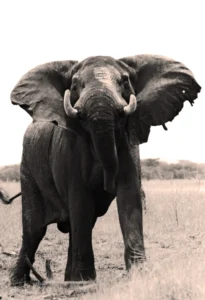
When we found Satani, he was standing quite still with his forehead pressed up tightly against a big yellow-trunked Mchibi tree. He looked old. Both his tusks had been broken off 10 centimetres forward of the lips. I walked up close and placed a bullet into his brain through his left temple. It killed him instantly.
As I watched him kicking a last tattoo in the air with his top back leg, I realised that this hunt, start to finish, had taken 20 long years to complete. It surely must be the longest elephant hunt in history.
Finally, when we examined Satani carefully, we found a suppurating bullet wound in his forehead. The following week we heard the sad news that Samuel had been killed by an elephant!
(This article was published in the November-December 2022 edition of SA JAGTER/HUNTER.)