











14 October 2026
Cast bullets for medium bore rifles
Most of us have had something to do with cast bullets at some point in our shooting careers. Cast bullets are, of course, as old as firearms themselves – they were the standard fodder of the first firearms and are still launched in the millions around the world but mostly in handguns. – BY BRIAN REILLY
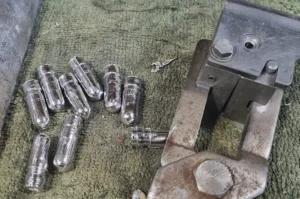
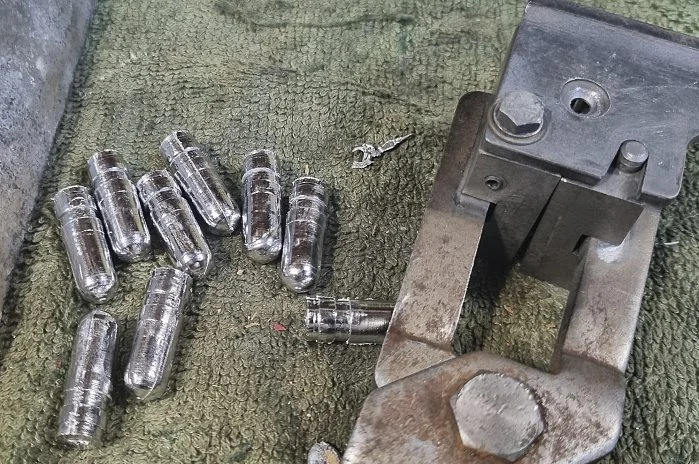
A batch of freshly cast bullets in the cast-iron mould made for me by Peter Carr.
My first exposure came not long after the acquisition of my first .45 ACP pistol when I realised that bullet casting would extend a student budget; this was after the purchase of only two boxes of precast bullets.
Bullet casting is a bit of a rabbit hole where every handgun added to the collection means a new mould and sizer dies and, of course, becoming a scrounger for scrap lead forevermore. Over the years, one gains the finer points of bullet casting together with all alloy mixes, temperatures, mould preparation and conditioning. Suffice to say I consider myself a competent and experienced bullet caster after many years of trial and error.
With reference to cast bullets in rifles, however, I’ve always been ambivalent and held the view that this would not be worthwhile, particularly regarding accuracy and the trouble one would have to go to for any sort of performance. But my hand was forced by the spiralling cost of bullets, particularly in the big bores, or more correctly, to use the British description, medium and large medium bores. This was all driven by the monthly club competitions that now include some form of big-bore competition at my club. For this, I mostly use the venerable 9.3×62, but the boxes of bullets on my shelf show that their prices have increased at least fourfold in the last five years.
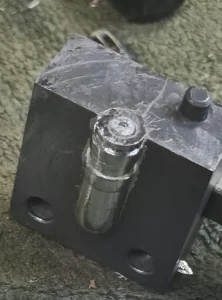
A cast bullet in the Peter Carr mould.
TAKING THE LEAP
Having decided to start moulding projectiles for my 9.3, it became clear that bullet moulds and sizer dies in the good old RSA and even the USA, for that matter, weren’t easy to come by as these moulds were mostly custom orders. I thus turned to my old friend Peter Carr, a machinist of note, to make a mould.
Luckily, mould dimensions are freely available on the Internet. Moulds are normally made from aluminium, brass or cast iron. Based on performance, my preference has always been steel (cast-iron) moulds. Their benefits are that they are less prone to warping, will literally last for centuries, and retain heat better, making for more consistent casting temperatures.
On the downside, they require maintenance, and rust is the eternal enemy that ruins steel moulds. Having established the profile and dimensions, I sourced some blocks of malleable cast iron thanks to another friend in the engineering business (this is cast iron in which the carbon content has been reduced by a tempering process that converts some of the carbon to graphite and makes for a tougher, less brittle cast iron better suited to machining). Then, it was over to Peter. As he lives in Port Alfred in the Eastern Cape, I am happy that I was not witness to the swearing and cursing that no doubt ensued.
Apparently, moulds are manufactured with standard “cherry” cutters for each bullet profile. In the handmade scenario, however, the split blocks are chucked up in the lathe and, once centred, cannot be removed until all machining is complete, with each groove being internally machined. This is sort of like describing the house by looking through the front door keyhole. I wasn’t going to push my luck and ask for a two-cavity mould – one cavity was all I needed.
Some trial casting with wheel weights produced a 9,3-diameter bullet of 270 grains at .367 thousandths-of-an-inch diameter after cooling. The mould duly arrived and was fitted to standard RCBS mould handles.
Bullets are cast from lead, but there is also a myriad of alloys that are applicable to the process. To prevent lead bullets from smearing lead into the rifling, various alloys are mixed in to harden the lead. Most lead available, particularly scrap lead, comes in different hardnesses.
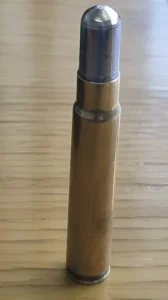
A 9.3×62 cartridge loaded with a cast bullet ahead of 35 grains of S335 propellant and 4 grains of Dacron.
GO HARD
For rifle bullets, obviously, the harder the lead, the better. The go-to alloy here is something called linotype, which is really hard and consists of 4% tin, 12% antimony and 84% lead. It goes without saying that if you can source the alloy, it could cost up to R200 per kilogram, which will produce about sixty 9,3 bullets.
Linotype was used by printing works to typeset the letters for bulk printing and can still occasionally be found from scrap dealers. It normally comes in 20 kg bars, and you may have to let the scrap dealers know what you are looking for. Luckily, I still have some on hand – let’s say enough for my son’s lifetime, seeing that he now considers my gun collection as already in his possession!
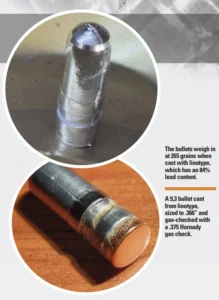
I’ve used several different commercial melting pots and casting systems over the years. However, there seems to be no substitute for a gas stove and a cast-iron pot with a pouring ladle, so that’s the set-up I use. It took about 30 bullets for the mould to become blued or conditioned and I had superb bullets in no time. They weighed in at 265 grains.
Although at moderate velocities a gas check or copper base is unnecessary, I had stipulated one on my diagram. But where to find these? I procured some .375″ gas checks from one of our dealers and hoped they would do the trick. The next step was sizing and lubricating the cast bullets. This step is not a necessity but improves consistency.
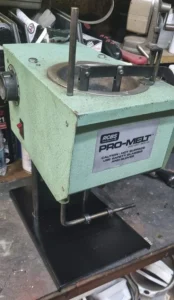
I’ve used several melting pots over the years, but the ladle and cast-iron pot on a gas stove still work best.
To make a sizing die, I took a standard .357 die, removed the centre plunger and chucked it up in the lathe. Now, these sizer dies are hard, and no tooling bit would touch it, but the Dremel with a small carborundum wheel attached to the tool post was able to slowly grind it to .366″ diameter. I turned up and hardened a new centre plunger, and I was in business. A top punch from some random handgun bullet was a suitable substitute for a dedicated top punch, although this one was still on my to-do list!
My standard 9,3 load chronographs at 2 364 fps with a 286-grain Hornady bullet. Clearly, I would have to reduce the velocity for the cast bullets, but this would leave me with excess case capacity, which is never a good thing. The pundits with experience with black powder express rifles loaded with smokeless powders were at one that I would have to use a Dacron filler and somewhere around 35 grains of S335 with my cast bullets.
Well, so be it. I loaded 35 grains of S335 behind a 265-grain gas-checked cast bullet topped with 4 grains of Dacron between the powder and bullet. Then, I proceeded to the range with some trepidation. What can go wrong, I asked myself as I chambered the first round!
The shot sounded fine, the recoil was reduced and the chronograph registered 1 960 fps. The following shots were also close and, surprise, surprise, at 50 metres, three shots cut the same hole at the same point of aim as their jacketed counterparts.
What I did find, however, was that I had to seat the cast bullets a little deeper to make the bolt closing a tad easier – obviously, the full patch shoulder was engaging the rifling. As a bonus, a thorough bore inspection showed very little leading.
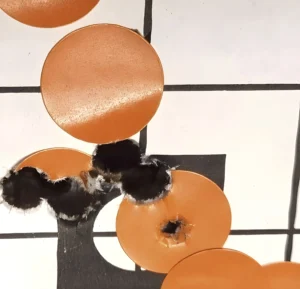
Two groups fired from the bench at 50 metres, with the cast bullets travelling at 1 960 fps.
All in all, it was a successful project with excellent results that yielded more practice with the 9.3×62. Where to now from here? Well, I’m looking at profiles for a .416 bullet, so I can shoot a bit more with that rifle of mine as well. The whole exercise has been well worth it from a cost standpoint. I would encourage anyone to go this route to be able to dust off those medium and large medium bores and use them a little more.
Anything related to the use of lead these days comes with a dire warning of the dangers of lead poisoning. Well, after 40 years of shooting and casting lead bullets, and having grown up with a mouthful of pellets and lead additives in petrol, I recently had my blood lead levels checked, and all was fine. Suffice to say, however, I keep the work area well ventilated and minimise my exposure to lead. Better to be safe than sorry.
(This article was published in the September-October 2024 edition of SA JAGTER/HUNTER.)