












12 October 2026
The brave birds of the 2 world wars
During World War II, the Allied Forces often used carrier pigeons to get messages across the enemy lines. One such a pigeon, Cher Ami, was awarded the Croix de Guerre Medal for heroism in battle. – BY KOBUS DE KOCK
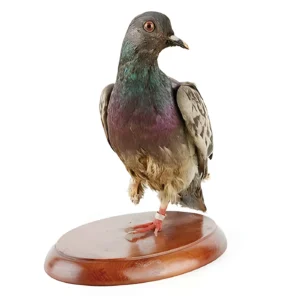
The famous war pigeon Cher Ami, on display at the Smithsonian Institution, Washington.
My radar picked up the first squadron of rockies coming in over the hills from the north. A loosely-spaced bundle of specs rapidly approaching the field of ripening sunflowers.
I felt a rise of excitement as I waited for the first birds to drop into the field. That magic of lightning-fast projectiles swooping past – whiffling to slow down and avoid predators, the wind rushing audibly over their wings.
Despite its mere 7,5 pounds, the M30 Luftwaffe Drilling felt heavy in my hands, hardly a snap-shooting English wand. The heavy 9,3-mm barrel below made it stable with great momentum, but difficult to stop and change direction. Would I be able to stop the invasion? When the first “war pigeons” dropped in, I relaxed. The M30 absorbed almost all the shock from the light 24-gram Eleys. And it hit where I pointed.
THE TRENCH WAR
WWI (1914-1918) was essentially a trench war. An intricately woven battle line of trenches stretched from the North Sea coast of Belgium for approximately 708 km to the border of Switzerland. The Germans occupied the north and the Allies the south. And there they sat and fought each other for almost four years. It was a brutal and ridiculous war, resulting in the death of millions.
One day gaining a few meters on the enemy, only to lose it again the following week. Attacking troops, if they managed to survive the sweep of bullets and shrapnel, had to jump down the enemy’s trenches and clean it out in close-fought hand-to-hand combat.
The United States’ President Woodrow Wilson was initially reluctant to join the war, favouring a possible collectively negotiated settlement. However, when Germany’s Paul von Hindenburg decided on unrestricted submarine warfare, which included passenger and merchant ships as fair targets, Wilson had no other option but to join the war. For the war-weary British and French, it did not come a moment too soon.

M30 Luftwaffe Drilling. Made by Sauer and Sohn, it was given to selected Luftwaffe pilots.
Trench conditions were often atrocious. The men had to cope with ankle-deep mud and bomb-crater puddles filled with water deep enough to drown in, lice and rat infestations, the stench of dead and rotting bodies and open-pit latrines. Such was the reception awaiting the American Expeditionary Forces in June 1917 when they entered the trenches at Nancy, France.
Having had the advantage of observing the war for a while, their troops were, in addition to the M1917 Enfield, fortuitously equipped with what were known as trench guns – Winchester Model 97 pump-action shotguns. Fitted with short 20-inch barrels, bayonet lugs and heat shields, the fast-firing pumps used buckshot to such devastating effect that the Germans wanted to pass legislation against its use! As if nine 4,5 mm balls of shot were any worse than flame throwers or mustard gas?!
But the Germans themselves did not use shotguns in WWI. Which is what I wanted to establish; did the Germans use shotguns when shooting down Allied war pigeons?
Hermann Göring, head of the Luftwaffe during WWII, did equip his Stuka bomber pilots active in North Africa with Drillings. The M30 Luftwaffe Drilling, built by Sauer & Sohn, was a beautifully-built double-barrelled 12B over 9.3x74mm. Essentially a survival weapon, it was also used by the pilots for trap shooting in order to sharpen up their eyesight.
Only 2 456 were built and apparently not routinely handed out to the pilots. Hermann Göring, an avid hunter, also gave them as gifts to dignitaries visiting his hunting lodge. So, if you have an M30 Luftwaffe Drilling coming to you in someone’s will, you may just have struck it rich.
The Germans mainly used the Gewehr 98 and the MG08 machine gun in WWI. Extremely accurate and reliable, the bolt-action 98 fired a 7.92x57mm cartridge. When they saw carrier pigeons going up and circling before heading for home, they simply threw up a curtain of lead. With the MG08 capable of firing 500 rounds a minute, it certainly makes the story of Cher Ami just that much more fascinating.

SENDING MESSAGES WITH PIGEONS
Homer pigeons were used extensively during WWI and WWII to carry messages – as an aid in the signal core when all other forms of communication proved inadequate. This is amazing. In an era when they were already building aircraft and submarines, they had to fall back on something as “primitive” as sending messages with pigeons! Almost a “cleft-stick” approach, I hear modern IT nerds saying.
All sides, including the Germans, French, United States and Britain, made use of carrier pigeons. A small metal canister was attached to one leg, in which a short message could be placed. Today, much lighter material is available, which I presume would have greatly improved results.
It is estimated that approximately 100 000 pigeons were used by all sides during WWI. Of these about 20 000 were killed in action.
I was taught that homer pigeons fly back to the loft in which they were hatched. This is an amazing phenomenon in the animal world which is still not fully understood. Magnetic navigation via magneto reception through iron molecules situated in the birds’ cere is just one hypothesis. (A bird’s cere is the fleshy, membranous covering of the base of the upper mandible of a bird, especially a bird of prey or a parrot, through which the nostrils open. – Ed.)
Racing pigeons regularly fly the length of South Africa at average speeds of 80 km/h plus. Beaufort West to Gauteng is a popular route. The 825-km race between Kimberley and Gansbaai is another astonishing one. Imagine having flown that distance only to hit a 50 km/h head-on South Easter when crossing the Kleinrivier Mountains before your welcoming loft in Gansbaai? Absolutely mind-boggling!
To learn more about the dark and secret art of pigeon racing, I went to see a retired Gansbaai pigeon fancier. Having flown his beloved birds for 55 years, he surely knew a lot and his stories kept me riveted all morning.
He explained how young birds could be “re-home”, which fitted in well with the war pigeon story. Older birds are difficult, and those with strong homing instincts are seldom successfully transferred. If the lofts were mobile, they could thus easily be moved to the front. Using the chassis of red London double-decker buses, the British built beautiful mobile lofts for this purpose.
My pigeon flying consulting guru is also of the opinion that homers can see 13 km! The picture “flew” into place. A moved loft will be found.
Wars did not require top-notch racers to fly huge distances. Back to squadron HQ 40 km from the front or crossing the English Channel (50 km direct distance between Dover and Calais) was easy for these magnificent flying athletes, hardly far enough to work up a sweat. If only they could get past the wall of lead thrown up by the enemy.
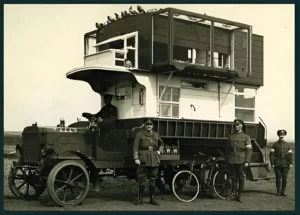
A moveable loft built on a London red bus chassis. The war obviously took preference over anything else.
Cher Ami (meaning “dear friend” in French) was a homing pigeon donated by the pigeon fanciers of Britain to the US Army Signal Corps in France during WWI. During the Meuse-Argonne offensive he delivered a total of 12 messages at Verdun, including one from a group of encircled soldiers (dubbed the Lost Battalion – although they were not a battalion), thus saving the lives of the 194 trapped men.
Early in October 1918 Major Charles White Whittlesey and 550 of his men were trapped behind enemy lines. Surrounded by Germans, their exact position was not known and they got bombarded by their own men. The “friendly” Allied fire soon whittled down the men of the 77th Infantry Division until eventually only 194 soldiers were still alive.
None of their runners could get through, so Whittlesey opted for despatching messages by pigeon. The first two got killed before Cher was sent off with the message: “We are along a road parallel to 276.4. Our own artillery is dropping a barrage on us. For heaven’s sake, stop it!”
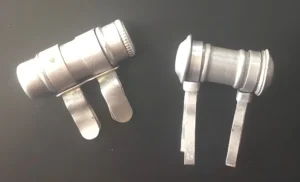
Metal canisters strapped to the pigeons’ legs in which the messages were placed.
Cher Ami also got shot down like the previous two. Fortunately, he managed to take off again and fly the 40 km to division headquarters in just 25 minutes! He had a bad cut on his chest, a leg hanging by a tendon and one eye blinded. Army medics stitched him up and saved his life. When recovered, he was put on a ship to the United States, where he eventually died of his wounds at Fort Monmouth, New Jersey, on 13 June 1919. His body was preserved and donated to the Smithsonian Institute.
Most reports say he was “shot” through the chest. Only one bulletin talks about the possibility of shrapnel, which I think is far more likely. No pigeon could possibly survive a 7,92 mm bullet through the chest.
Cher Ami was awarded the Croix de Guerre Medal with Palm and Oak Leaf Cluster (a French military decoration for individuals who distinguish themselves by acts of heroism involving combat with enemy forces) and the gold medal from the Organized Bodies of American Racing Pigeon Fanciers.
In 1931, he was inducted into the Racing Pigeons Hall of Fame and in 2019 became one of the first animals to be awarded the Animals in War & Peace Medal for Bravery.
An article by Dwight Jon Zimmerman, “Cher Ami: The One-eyed, One-legged Pigeon Who Won the Croix de Guerre”, is a full and fascinating account of this brave war pigeon. He wrote the story to commemorate Cher Ami a hundred year after the incident. See www.defencemedianetwork.com.
But Cher was not the only pigeon decorated for bravery. Britain’s PDSA alone awarded 32 Dickin Medals during WWII. The Dickin Medal is the animal equivalent of the Victoria Cross, and was named after the PDSA founder, Maria Dickin. Their stories are all well documented and make fascinating reading, which make one stand in awe and wonder at these brave and intelligent feathered athletes.
The domestic pigeon, Columba livia domestica, and its approximately 1 000 different breeds all originated millennia ago from the rock pigeon, Columba livia, which had a historical resident range in Western and Southern Europe, North Africa and South Asia. The Romans already used carrier pigeons some 2 000 years ago.

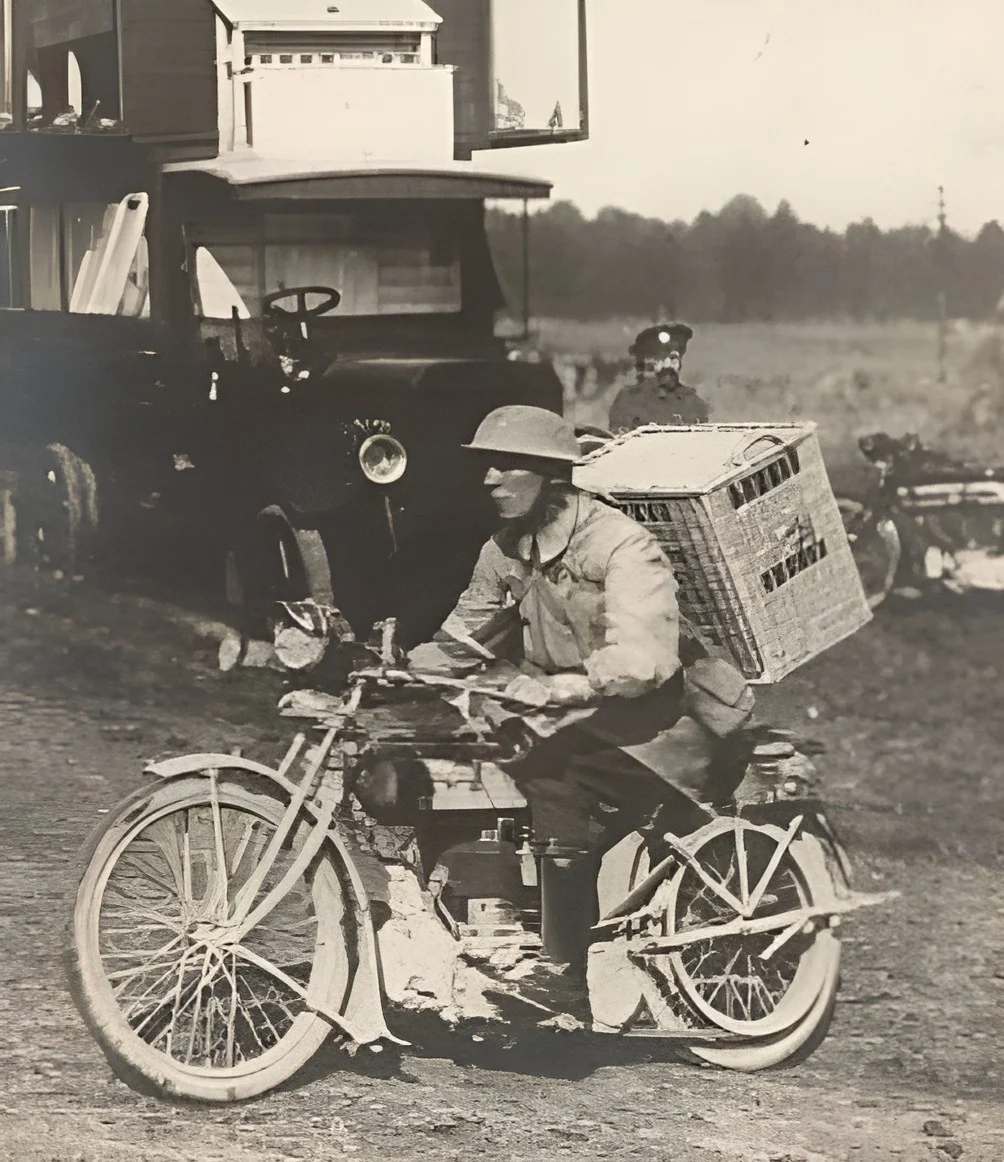
War pigeons leaving for duty in the trenches. With a bit of luck they would make it back “home” and deliver their messages.
Our rockies, now called speckled pigeons, Columba guinea, is also a relative. Natural crosses occur and pigeon fanciers have deliberately tried to cross them, my pigeon guru told me. However, the crosses did not have the speed or stamina of true racers.
The first couple of rockies outflew my gun and in the midday sun I became reluctant to shoot these brave little fellows any more. Could it be that some form of remorse was setting in? But the farmer was pleading and the proffie from Kovsies did say that he thought the only way to limit their numbers was to shoot them. Bear in mind that he was talking to a bunch of wingshooters. So, I “shouldered” on, the war pigeons and the M30 forgotten. It was just me and my trusty old SKB and Polka weaving through the dry sunflowers.
(This article was published in the Maart-April 2024 edition of SA JAGTER/HUNTER)