







6 October 2026
Bullet… what is it good for?
If a bullet isn’t the same as a cartridge, then what is it exactly and what is the different bullets used for?
Pierre van der Walt explains: A bullet is the part of a cartridge that is launched through the air and impacts on the paper or living target. A synonym for bullet is projectile.
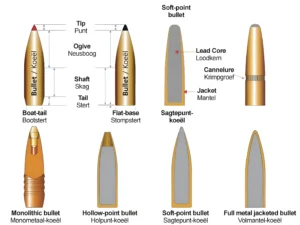
The correct terminology of a bullet and its constituent features are detailed in this sketch.
BULLET APPLICATION TYPES
Bullets are designed for different applications. For purposes hereof, I am going to categorise bullets in just three major fields of application:
- Match/competition bullets
- Varmint bullets
- Hunting bullets
Match bullets: These are actually very simplistically constructed bullets. If of monometal (copper alloy) construction, the focus is on streamlined, high ballistic coefficient (BC) shape, extreme shape and tolerance uniformity and with a very critical centre of gravity often positioned by using a hollow-point configuration.
In the case of 4th generation (jacketed lead-core) bullets, the lead is wrapped in a very thin jacket of predominantly uniform thickness. The thicker the jacket of a bullet, the higher the risk that the jacket thickness uniformity can be compromised during the extrusion process. If the jacket is thicker on one side than the other, the lead core will be off-centre inside the jacket. That will cause it to spin imperfectly; it will spin unstably around its longitudinal centre or axis and will gyrate around it. This is detrimental to precision (group size).
Match bullets are great for bragging rights on a range, but their performance on game can be, and mostly is, very erratic. They either behave like a solid and punch a small hole right through the animal with minimal blood vessel damage, or they explode on the skin surface upon impact without penetrating.
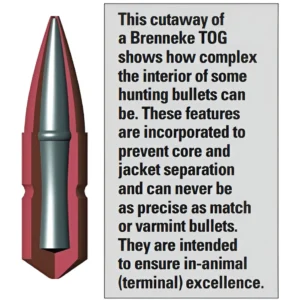
Hunting bullets: These bullets normally have much thicker jackets that become thicker towards the bullet’s base or tail. Others have intricate features to enable them to reliably expand (mushroom) upon impact without complete fragmentation. These core-retaining features can take the form of multiple cores (such as the PMP ProAmm bullet), ridges or traps (Hornady InterLock) on the inside of the core, jacket partitions or even external crimping of the jacket (Sierra ProHunter) to trap some lead behind the crimped area.
The core can be fused (bonded) to the jacket. The long and the short of it is that the more complicated the core and/or jacket design, the more difficult it becomes to eliminate variation. Hunting bullets are designed to expand upon impact, create a large wound channel and cause rapid haemorrhaging, as well as to retain weight and momentum to penetrate to the animal’s vitals. This is achieved by more complicated jacket designs and shapes than match bullets. Although still capable of incredible precision, hunting bullets are not intended to be as accurate as match bullets.
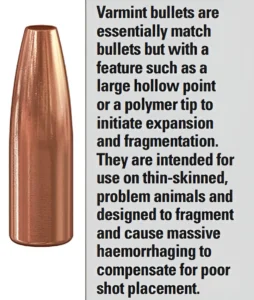
Varmint bullets: Varmint bullets are essentially high-BC match/competition bullets but with a tip area designed to guarantee expansion. This expansion is quite violent due to the thin jacket and this type of bullet does not penetrate as well as hunting bullets. The idea behind them is to save the far side of the pelt but still pulverise the vitals for rapid death.
BULLET BASE CONSIDERATIONS
Most hunting and target bullets are spitzers. Base shape is another consideration. The most common base shapes are either flat base or boat tail. Due to its more streamlined rear section, boat-tail bullets offer a flatter trajectory than flat-base bullets, but only really reach their potential beyond about 275 yards. Up to that distance, the trajectory differences are effectively insignificant and flat-base capability is largely underestimated. A trajectory comparison is provided in the below table.

The bullet exit from the muzzle is also less traumatic for flat-base bullets than for boat-tails. Flat-base bullets stabilise much sooner after the muzzle exit than boat-tails. This explains why they tend to deliver better groups at short range (say 100 yards) than boat-tail bullets, but from 200 yards or so, boat-tail bullets have had enough time to “go to sleep” (fully stabilise) and group sizes even up.
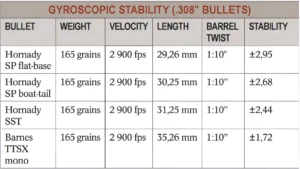
Bear in mind that streamlined boat-tail bullets of the same generation (say, jacketed lead-core bullets) are generally longer than their flat-base counterparts and are also gyroscopically less stable in flight. Monometal bullets are even longer per given weight.
(This information comes for the article ‘Pierre’s reloading bench. Rifle bullets: Part 1’ published in the September-October edition 2024 of SA JAGTER/HUNTER.)