

1 July 2026
The Glorious Greywing
“Take my breath away…”
THE greywing partridge has long been extolled with superlatives ranging from the Crown Prince to the crème de la crème of Africa’s terrestrial gamebirds. And I must agree that – all things considered – the greywing is the most challenging and exciting of this category to hunt. They also make very good eating, though not quite as good as their larger cousins.
But first, let’s get this irritating taxonomy thing out of the way. Is the grey-wing a partridge, a francolin or a spur-fowl? Ornithologists are divided on this issue. In my younger days, at least in Natal English, all such birds were called partridges. If memory serves, publications began to use the term francolin around the 1970s, and debates arose as to which of these birds were which. Some writers renamed all of them fran-colin, and initially, the greywing’s scientific name was Francolinus africanus. In 2005, AGRED (African Gamebird Research, Education and Development Trust) published their superlative refer-ence book, Gamebirds of South Africa (text by Dr PJ ‘Slang’ Viljoen). In this monumental work, AGRED retains the name ‘partridge’ for some of the family, while using ‘francolin’ for others. Their decision was that the greywing should remain a partridge. Its scientific name was changed to Scleroptila Africanis (a bit puzzling, as the Latin word scleroptila translates roughly as ‘hard eyes’ or ‘hard skin/leather’).
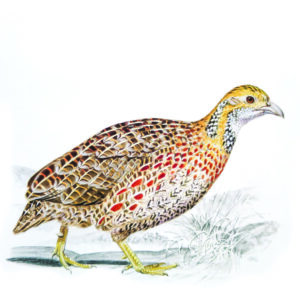
A greywing partridge painted by Penny Meakin. (AGRED’s Gamebirds of South Africa by Dr PJ Viljoen, 2005)
I’m not qualified to challenge these arguments, so I’ll just go with AGRED on this one and call this bird the greywing partridge, or just the greywing. Some-time later, ornithologists at the Fitzpat-rick Institute (University of Cape Town) abandoned the name partridge, instead coining the term ‘spurfowl’ (a reference to the spurs on the backs of the legs). I have no doubt that they had valid scientific reasons, but I’m sorry, I’m just not going there – to my layman’s mind the term ‘spurfowl’ is way too broadly encompassing. For most people, when you say the word ‘partridge’ or ‘fran-colin’, an image of a specific type and size of bird comes to mind. The term ‘spurfowl’ however, includes farmyard roosters, turkeys and even peacocks.
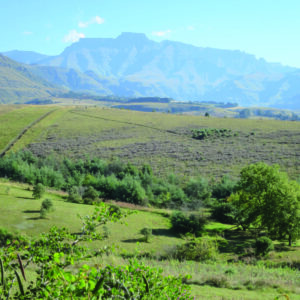
Natal Drakensberg greywing terrain. The tree-line ends here, the birds are mostly in the hills beyond.
The fact is, the common names of creatures are unimportant, as long as we know what creature is being discussed. I grasp that all branches of science pro-gress, particularly since the advent of DNA, and that errors must be corrected. But we have scientific (Latin) names for that – by all means, go ahead and change those, for the same Latin names must be recognized by scientists univer-
sally. But whether I call Orycteropus afer an ant bear (which it’s not) and you call it an aardvark (earth pig, which it’s not) is of no consequence.
The guineafowl occurs throughout most of tropical and subtropical Africa, yet it retains the name given to it by the Portuguese who first discovered it on the Guinea Coast of West Africa. Its Afrikaans name is tarentaal, which has no English translation other than ‘guineafowl’. In Namibia, the Germans call it the perlhuhn (pearl fowl, referring to the white spots on its feathers). None of this matters. Nor does it matter whether a greywing is a partridge, a francolin or a spurfowl.
The greywing is often described as easy to confuse with the redwing, Shel-ley’s and Orange River partridges. I have never seen an Orange River partridge, but the greywing does look similar to the redwing and the Shelley’s. However, in flight, the greywing has a distinctive greyish look (hence the name), just as the redwing’s rufous colouring is notice-able. The greywing’s throat also appears speckled greyish, whereas the Shelley’s and the redwing’s are distinctly white. But for me, none of these smaller par-tridges is easy to identify when singles or pairs suddenly explode from the grass at full speed while you’re raising your gun and trying to judge a shot before they get out of range. Numbers help – if a covey of a dozen or more flush with
high-pitched squeals, they’ll be grey-wing. Redwing coveys are smaller and
seldom call on flushing.
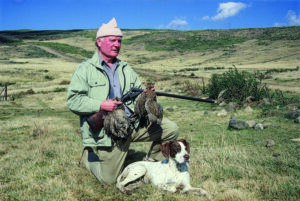
Author and pointer with greywing partridges shot in the East Cape Drakensberg near Lesotho border, 2 700 metres above sea level.
What makes the greywing the grand-est? Let’s start with the challenge pre-sented by its habitat. In South Africa, the greywing is the most widely distributed of all the partridges and francolin, but generally occurs at altitudes higher than 6 000 feet (1 800m) above sea level. In the fynbos vegetation areas of the southern Cape, some may be found at coastal level, but for the most part, we’re talking mountains here, and gen-erally above the tree line – ‘montane grassland’.
The greywing is endemic to South Africa and Lesotho. My experience is lim-ited to KwaZulu-Natal and the Eastern Cape, where the Drakensberg mountains get freezing cold in bird-hunting season, and the icy wind cuts through you like a sabre. You start out needing warm cloth-ing, but the effort of climbing up and down the steep slopes soon has you shedding clothes which become a bur-den. When I was close to 60 years of age, I hunted greywing near Rhodes in the Eastern Cape, close to the Lesotho border, at 9 000 feet. My first outing was the day after I had travelled there from sea level, so I was not acclimatized to the altitude. I could hear my heartbeat in my ears, and it sounded like a Harley Davidson. I tired rapidly. After that, we rode horses to get from one area to the next, then hunted on foot. Using horses also solved the clothing problem. So, the first thing you need to know about grey-wing hunting is that you need to be fit. The upside of their terrain is that you will be hunting in some of the most splendid scenery imaginable.
Secondly, do not attempt it without the services of well-trained pointers. Greywing are secretive and tend to be reluctant flyers. In the absence of well-trained dogs, the birds will either keep running ahead of you, or simply remain hidden and let you unknowingly walk right past. Without dogs, unless you happen to step right onto a covey, you will most likely walk all day without get-ting a shot. If possible, use pointers hav-ing specific experience with greywing, as these birds are particularly testing. And be constantly ready – I have seen lone greywing sit tight within inches of the dog’s nose, flushing only when you almost step on them, but I have also seen them flush several metres ahead of the moving dogs before they even go on point.
Slang Viljoen writes that greywing prefer medium to short perennial grass of medium density, hence benefit from areas subject to moderate grazing. They avoid severely overgrazed or frequently burned areas. They are typically found where large slabs of rock occur, which provide a suitable micro-environment for the types of plants that produce the subsurface bulbs which form the bulk of their diet. Other sources state that in addition to bulbs and tubers, greywing also eat invertebrates. They breed between spring and late summer. Hunt-ing seasons may vary from province to province but are usually between May and July.
In Game Ranch Management, 4th edition, Dr Viljoen suggests that, after a good breeding season, up to 25% of a francolin population may be harvested. But obviously, individual covey sizes must be taken into account. Small cov-eys should never be reduced to fewer than three or four birds. In a covey of 20 greywing, take no more than six birds.
Greywing usually flush in coveys varying in size from four or five to a dozen, but sometimes in pairs and singles. The first time I flushed a covey, it comprised about twenty birds and their deafening take-off came as a paralysing shock. They flew directly away from me, and all closely bunched together, allowing me no chance of a shot. In my limited experience, greywing are generally low fliers – unlike crested and Swainson’s which sometimes offer high shots.
To locate these birds, listen for their calls, which are mostly heard in the early morning and at dusk. I have read several widely differing descriptions of their calls, quite confusing to the reader, though admittedly, greywing calls are extremely difficult to describe in words. To me, that of a single bird is a complex three-syllable call, starting with a brief, low “kwi” followed by an elongated, high-pitched squeak, then lowering to a softer, dual-vowel sound. The best I can do is: kwi-squeee-cheuw. When several greywing call together, it comes as a jumbled cacophony of short up-and-down sounds. When a covey is flushed, they all utter a series of high-pitched squeaks.
Now let’s get to the main reason why the greywing is regarded as the grandest of our terrestrial gamebirds. He is prob-ably the fastest flier, so you need quick reflexes; you have to shoot sharply, for he rapidly gets out of shotgun range. Often hunted in gusty conditions, his flight is trickier than most, making full use of the wind to jink or veer this way or that and to speed up his escape. He is among the smaller in body size of the partridges and francolin, hence is harder to hit.
Then there is the sheer, shocking thrill of a greywing covey’s take-off. There are usually numerous birds involved; it is sudden and thunderous, often very close, and pitched with cries – it takes your breath away. If the covey is large, you can follow it up after the first flush, putting up singles and pairs.
Greywing sit very tight; often one will flush literally from under your feet, and at your shot, another will explode from the grass behind you, flying in the opposite direction. A third might ignore both your shots, only to explode away just when you have broken open your gun and are busy drawing a cartridge from your belt. Sometimes, if you’re on
a steep hillside, on first flushing, the whole covey will fly downhill, remaining airborne for a long distance, ruling out a follow-up. With greywing, every flush is different, every flight is different, every shot is different.
Most of your shots will be at 20 to 30m. Shot size is a matter of personal preference; mine is for number 6s. In mountainous terrain, a lightweight gun is a help in terms of portability, and is fast into action. Most local shooters use 12-bores, but a 20-bore would do fine. And you don’t need heavy shot-loads for
greywing.
A few tips: get properly fit – not just jogging fit; go climbing in steep, rough country. Take good, well worn-in boots with appropriate socks, and clothing that is lightweight but warm, including wool-len mittens. Wear a woollen beanie – it will keep your head and ears warm and won’t blow off in the wind. If you are a coastal dweller and will be hunting at very high altitude, try to get there a
couple of days ahead of your actual hunt so as to acclimatise before exerting yourself. And don’t forget your lip-ice.