



1 July 2026
Understanding Trackers
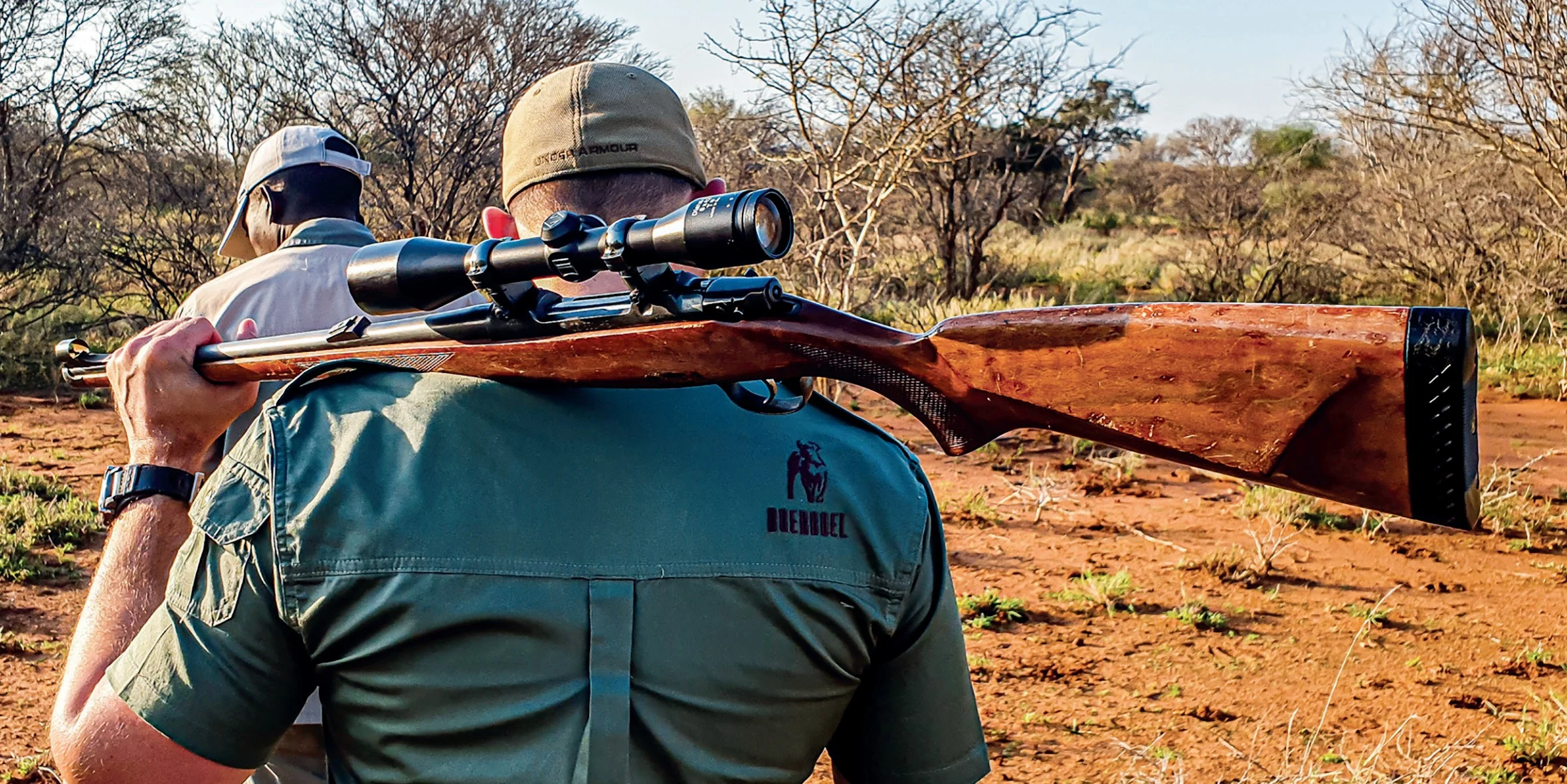
ON SAFARIS in wilderness areas in Africa, the indigenous local tracker is the most important element for success. Many PHs guiding foreign clients are also competent trackers, yet cannot afford to risk hunting without an expert local tracker – the stakes are too high. Many use two trackers, and only the best of the best. Most such trackers were once subsistence hunters or poachers hence are also expert hunters.

This Namibian tracker had never before seen a hunter leopard-crawling to stalk an animal.
Hunting in southern Africa has changed enormously these past 50 years, due to the advent and growth of the game-ranch industry. Naturally, top-rate ranches catering for foreign hunters ensure that they employ expert trackers – most started as six-year-old herdboys who had to learn to track lost or wandered goats and cattle. However, many game ranches cater for local hunters, and the facilities vary widely according to price. On some, the owner or his manager accompanies the hunter, but in most cases the hunter is assigned a guide and tracker, and the expertise of these employees can differ widely.
It is in the rancher’s best interest for you to bag your game, so most employ guides who are competent and know the most likely places to find game; many are also adept trackers. But in some cases the man accompanying you may be neither an experienced hunter nor tracker – he is largely there to see that you don’t get lost or cross the farm’s boundaries, and to report missed shots and wounded animals, which you will be charged for.
I was hunting with such a tracker when we came across two gemsbuck that were too far away for the borrowed .458 Win Mag I was using. It was fairly open terrain, so I told the tracker to stay put while I leopard-crawled closer. I shot one of the bulls and when the tracker approached he was wide-eyed and shaking his head. He told me he had never before seen a hunter leopard crawl!
For the most part, you will be in good hands, but even then, upsets can occur due to misunderstandings and miscommunication. One cause of this is the inability of the hunter to see things from the point of view of his tracker/guide. Of course, trackers and guides who have done this work for some years will have learned clients’ wants and ways, however strange these may appear to them. And they will have learned to judge and to tolerate a hunter’s potential weaknesses, such as his inability to see game in the bush – common in novice hunters. However, you may get a man who is good at tracking and finding game, but relatively inexperienced in hunting with sportsmen, and this is where the misunderstandings occur, resulting in failed hunts and potentially expensive mistakes.
Many novice hunters are unaware of the importance of wind direction, and want to take a route other than that which the tracker has indicated. If you are relatively inexperienced, listen to your tracker – the odds are he will know far more than you do. Likewise, some novice hunters are unaware that wild animals are spooked by unfamiliar sounds like clinking metal and human voices. A tracker will soon tire of getting you close to game only to have you spook it by talking or clanking your binoculars against your rifle.
It is important to consider the tracker’s background and culture. You don’t have to know it, you just need to consider that it’s likely to be quite different from your own. Guides and trackers are hired for their skills, and the nature of such skills usually indicates that they emanate from deeply rural environments, so he is likely to be very close to his tribal culture, traditions and beliefs. For example, many trackers do not understand why anyone would hunt animals for their horns. In their culture, hunting is for meat. If you want a trophy, be sure your guide/tracker understands your wants before you go out. If necessary, get someone who knows his language to explain that you want the biggest horns he can find in the time avail-able. If he doesn’t know this, and you pass up the first couple of rams he finds you, he could well lose interest in working for you.

This man was a good tracker and a keen, hard worker, but he walked too fast for me when hunting, diminishing the chances of spotting close game in bushveld.
In the Africa of old, many hunters wrote that their gun-bearers believed it was rifle’s noise that killed the animal. You won’t encounter such notions on game ranches today, but some trackers and guides have little concept of shot placement or bullet performance. They’ll expect you to shoot an animal standing at any angle. And sometimes their excited urgings persuade hunters to take shots that result in wounding.
As a young man, I hunted for many years on a vast cattle ranch in Rhodesia, and usually with the same tracker, Simon. During our excellent relationship, we tracked a very elusive eland bull for three days, but the few glimpses we got of him did not afford me a shot.
On the last afternoon before I was due to leave, we came on him in fairly thick bush, but all we could see of him was his backside and his swishing tail. Simon had worked so hard and so expertly for three days and now he was pleading with me to shoot quickly, as this bull never stood still for long. He could not understand my hesitation, and I felt pressed into doing something I shouldn’t have done. I deliberately aimed for the bull’s hip joint, knowing a massive eland bull cannot run far with a broken hip. Luckily, it worked. He went down and I sprinted up to finish him. But it could easily have ended very badly, and I determined never again to be pressed into taking a non-fatal shot.
Likewise, some trackers observe how rifle bullets can break through heavy bone to penetrate huge animals, and find it hard to believe that a few leaves or twigs can deflect a bullet from the target vitals. If they can see any part of an animal, they’ll strongly urge you to shoot through a screen of bush. (I might add I have met many fellow hunters who share the same sentiments!) If the animal escapes wounded, it can be a very expensive mistake.
I hunted with a tracker once who wanted me to shoot at an animal I considered too distant. He flatly refused to believe that bullets did not travel in a straight line. When I explained that bullets go further than a thrown spear or a stone, but also drop to the ground as they do, he shook his head, insisting that bullets are not thrown but have special power beyond our understanding. He was not alone in this perception. I read of one tracker who pointed out a big eland bull to the hunter and expressed great annoyance when the hunter refused to shoot it. Explanations that his .270 Win was not up to the job were summarily rejected.
Think twice before you ask your tracker’s opinion as to the distance at which an animal is standing. If he has been guiding hunters for many years, and listening to their talk, he may be able to advise you. But in many cases, his perception of distance will not be one of yards or metres beyond relatively short distances. Many have simply never had cause to make such estimations. Likewise, most city-dwelling friends I have taken hunting had no ability to judge distance in the veld beyond 50m or so.

PH ‘Squirrel’ Meredith’s first-rate tracker testing the breeze with an ash-bag. Many novice hunters don’t know the importance of wind direction.
Some trackers do not understand our aversion to bloodshot (bruised) meat and why we feed it to our dogs. They are delighted when we decline to take it home – it leaves more for them. Keep in mind that many such people get to eat very little meat, and to them, meat is meat, nothing is discarded. Always remember to take appropriate plastic bags for the animal’s offal which your tracker will regard as a delicacy and an important source of protein. Trackers are devastated when hunters gut animals in the veld and leave the offal there for the jackals just because they don’t want to risk smelling up the back of the bakkie. Consider the trackers’ point of view.
Many trackers take omens very seriously, especially those in wilderness areas where dangerous game occurs. The appearance of certain animals, reptiles or birds in certain circumstances can be a bad omen, rendering the tracker reluctant to continue in that direction. Don’t force the issue, because he might just see to it that he loses the spoor or avoids finding the game. And do not dismiss his fears; remember, you are dealing with a man’s spiritual beliefs – his religion.
If you want your tracker to work diligently for you, don’t treat him as a mere hired hand there to do a job. Get to know him. Ask about his family. Make friends with him, share a joke with him. Praise him; shake his hand after a successful hunt – preferably the African way, alternating your grip from his fingers to his thumb once or twice. And reward him appropriately for a job well done. You’ll make some fine friends and it will benefit you, especially if you return to hunt on the same ranch again.
I’ll end with a tragic story of the best tracker I ever worked with. I’ll call him Phineas. He began as a young tracker on a major 5-star game ranch catering mostly for foreign hunters. Born to tracking and hunting, he soon became their top man. On invitation, I did three long, hard, walk-and-stalk hunts alone with him – the owners particularly wanted me to bag good trophies, and we succeeded. Phineas could interpret the tiniest shiny mark on a rock as not only made by the hoof of the very animal we were tracking, but also revealing its precise direction.
Phineas was delightfully congenial and very good at hand-ling clients. Consequently, the ranch owner sent him to a PH school and he qualified. He was knowledgeable about local history, politics and other subjects that foreign clients ask about. He had a driver’s licence and the ranch owner bought him a hunting rifle.
The ranch employed numerous trackers, skinners and other staff, and one day six of these men conspired to murder the ranch-owner and his wife in order to steal and sell their considerable firearm collection. Other staff heard of the plan, and a horrified Phineas tried desperately to talk the six out of it, arguing that the ranch owners had been exceptionally good to all of them. But the conspirators were determined to carry out their plan. To prevent this, Phineas took his rifle and shot dead all six of them, and then shot himself. The distraught rancher told me of this shortly afterwards, so the details are accurate.