



1 July 2026
Crucial to Conservation
The 55 000 hectare Pilanesberg National Park, also known as the Pilanesberg Game Reserve, is a wildlife conservation area situated in our North West province and is well-known internationally. In 1979, this area was part of the then Bophuthatswana Homeland. In that year Pilanesberg was proclaimed a National Park and was administered by the Bophuthatswana National Parks Board. Over the years, various wildlife protected areas have been reclassified and Pilanesberg is now officially designated as Pilanesberg National Park.
In 1838 and thereafter, the hunters and travellers who passed through this area and the nearby Magaliesberg or Cashan Mountains recorded abundant game populations of various species, including elephant, buffalo, giraffe, white rhino, kudu, zebra and sable.
The mountains in Pilanesberg and the surrounding area abound in Iron Age sites and early settlements where Iron Age smelting works, furnaces and slag left over from the smelting process are still to be found. Weapons such as spear- and arrowheads have also been discovered here. Those early inhabitants of the Reserve hunted the game animals and made use of the meat and skins. Hunting was a part of their culture and livelihood.

No doubt the weapons were also used to defend the early inhabitants and their livestock against predators.
Certainly leopard, brown hyena, jackal and other minor predators would have been present, as those particular
animals occurred naturally in Pilanesberg before it was proclaimed a protected wildlife Reserve and they are thriving there today.
The early hunter and explorer, Captain William Cornwallis Harris, records hunting lion to the north of present-day Rustenburg and the Magaliesberg Mountains – not a great distance from Pilanesberg. As time marched on, other settlers arrived in Pilanesberg in their ox wagons and they possessed firearms. Hunting was also part of their culture and livelihood. They too, no doubt, defended themselves and their livestock against predators.
Now, when Pilanesberg was proclaimed as a wildlife conservation area, all hunting ceased – for a time that is. You see, hunting was re-introduced in Pilanesberg after it was proclaimed a National Park in 1979. That was a controversial issue then and remains so still today. Hunting was used as a management tool and formed part of the wildlife management policy. It was also used to generate much-needed income for the Board to perform its wildlife conservation mandate. Some of the very animals placed there for conservation purposes were hunted by overseas trophy hunters.
The anti-hunting fraternity certainly had much to say about that decision. Some other conservation bodies in the country and beyond our borders also questioned that management decision taken by the Bophuthatswana National Parks Board in 1982. There will always be hunters and non-hunters, and it’s unlikely the two will ever peacefully share the same campfire. We should however, respect each other’s point of view on this subject.
The management policy for wildlife within the Board was, and still is, based on the Sustainable use of Natural Resources. The key words here are “sustainable use”. In the initial concept and management plan for Pilanesberg, a section of the Reserve was zoned for Sustainable Use, and this included hunting and live game capture.
Over a period of time, white rhino were introduced from Natal Parks Board reserves, eventually numbering some 120 animals. About 60% of these animals were bulls – the sex ratio was totally skewed. Furthermore, 6 000 game animals of different species were introduced during this early development period. At the time, that was the largest game introduction exercise ever undertaken and was termed Operation Genesis. These animals thrived in their new environment and multiplied accordingly.
At that stage, tourism was in its infancy; income generated from that source was negligible. Visitor numbers to the Park were extremely low. The Director at that time, Dr Jeremey Anderson, had the idea to hunt some of the rhino bulls and excess game to generate income for the newly proclaimed Reserve. The Board approved his idea on the condition that he could obtain the support of the South African Nature Foundation and members of other SA conservation bodies.
In Bloemfontein, a meeting was convened of members of the South African Nature Foundation, the South African Wildlife Society, and prominent members of some other SA conservation bodies. Dr Anderson put his point across well and his proposal was accepted, with the proviso that he first canvass the opinions and receive the support of some prominent wildlife conservationists from the private sector. This was duly achieved, but a positive outlook from the media had yet to be gained. Dr Anderson invited well-known wildlife journalist, James Clarke, to Pilanesberg, showed him around and explained to him the reasoning behind the hunting concept. With this practical information at his disposal, Mr Clarke then published a positive article on the hunting issue. At that time, the Board further decided that, as visitor numbers to the Reserve increased, and income was generated from tourism, so hunting would be phased out and eventually cease.
And so, the Bophuthatswana National Parks Board allowed hunting for profit to take place within Pilanesberg, a proclaimed wildlife conservation area – a bold and controversial decision indeed, but based on the wildlife management principle of sustainable use of natural resources.
The hunting operation was strictly controlled, being supervised by staff from the Reserve. A registered Hunting Outfit was established and managed within the Board. The hunting was conducted in a section of the Reserve designated for this purpose, which was outside of the tourist or visitor areas.
An aerial game count was conducted during August and September each year, and these figures were used to determine and set a quota of animals of each species to be hunted. The white rhino quota was set at five bulls per year. Species whose numbers had yet to reach the Reserve’s desired carrying capacity were not included in the hunting quota. At the time, twelve of the twenty species present in the Reserve were identified as huntable.
A butchery and meat handling facility was constructed and duly registered, selling the game meat for R1.00 per kilogram, which greatly benefited the surrounding community by providing affordable protein right on their doorstep. Trackers and skinners were employed and trained. A very comfort-
able tented hunting camp was constructed in the designated hunting area and staff were recruited and trained to manage it, creating further employment opportunities.
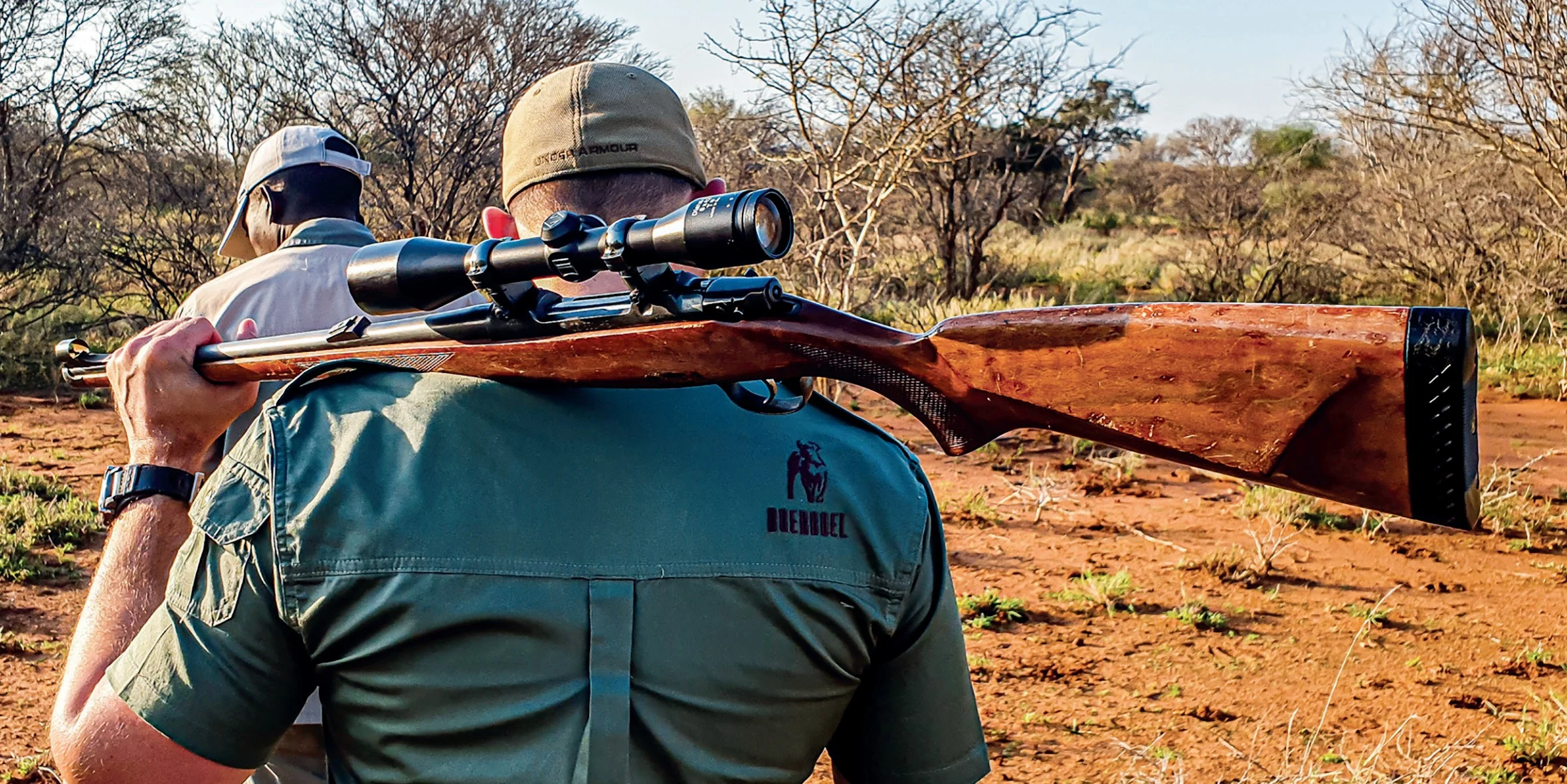
The marketing campaign initially targeted American hunters; this proved very successful, and soon hunters from many other countries availed themselves of this opportunity. As a member of the field staff in Pilanesberg during this period, I was actively involved in the hunting operation and conducted many of the hunts.
As anticipated, a great deal of income was generated not only for Pilanesberg, but for South Africa as a whole, as the hunting clients spent millions of dollars on other tourism-related products and entertainment. Many chose to have their game trophies processed by local taxidermists, injecting much foreign currency into that industry and a number of local businesses and communities reaped the benefits.
Tourism increased over the years and Pilanesberg became world-renowned for the enlightened wildlife management and conservation practices of the Board. This was a classic example of hunting and wildlife conservation working hand-in-hand and complementing each other.
Faithful to the original policy decision, as tourism increased, the hunting operation was phased out and ceased in the early 1990s. The hunting camp, which was located in a secluded valley overlooking a waterhole, was converted into a popular tourist facility generating much income.
Pilanesberg has come of age and hunting played a significant role in the early development of this iconic wildlife conservation destination.