




Discover the history of John Rigby, from its beginnings in 1775 to the development of legendary big-game rifles such as the .416 Rigby and the modern Rising Bite. – BY JOHAN VAN WYK

Rigby’s Big Game is a stout, dependable rifle made for hunters who venture to far-off lands in search of dangerous game.
History has not recorded what made the first John Rigby decide to enter the gunmaking business in Dublin, Ireland, in 1775. But whatever it was that stirred his emotions, it clearly worked because Rigby soon earned a reputation as a first-class maker of not only rifles and smoothbores but duelling pistols as well, at that time a gentlemanly (if noisy and sometimes painful, even deadly) way of settling disputes.
However, history has recorded that Rigby is the oldest gunmaker in the English-speaking world. In spite of trials and tribulations (which we will shortly get to), the firm is today forging ahead and once again concentrating on its core business: making first-class firearms for discerning sportsmen and -women.
In 1818, after the first John Rigby’s death, his sons, William and Jason, took over the family business. Things changed yet again when William Rigby died in 1858 and his son, also called John, joined the company. John Rigby the Second would bring great fame to the Rigby firm as he was a famous target shooter who won the prestigious Wimbledon Cup several times. He also developed the renowned Rigby Match Rifle, which, along with other noteworthy target rifles of the era, such as the Gibbs-Farquharson, gained an excellent reputation for accuracy over time. Therefore, Rigby also became an established maker of target rifles in addition to its normal run of rifles as well as shotguns.
John Rigby the Second eventually spearheaded the opening of a London branch of the firm at 72a St James Street in the city’s prestigious West End in 1865. By this time, the Rigby firm was closely involved in developments for both the civil and the military markets.
In 1887, John Rigby was asked to become superintendent of the Royal Small Arms Factory at Enfield Lock. In this position, he was privy to the latest developments in military small arms and was instrumental in solving the teething problems of the British Army’s newest service rifle, the then new Lee-Metford in .303.
In service, it was found that early Lee-Metfords tended to wear out their barrels. The problem was eventually traced to the shallow, elliptical, Metford-type rifling in the barrels of the rifles. The shallow rifling tended to cope poorly with fouling and thus wore out in short order, leading to a fall-off in accuracy. Under John Rigby’s guidance, a change to sharper Enfield-type rifling was made, and barrel life was increased markedly. The Lee-Enfield, as the rifle subsequently became known, would remain in service with the British Army until the late 1950s – with Enfield-type rifling!

Rigby’s Bell Edition Highland Stalker is supplied in a custom canvas case with cleaning accessories, a Rigby knife, a copy of the original rifle’s ledger entry signed by Marc Newton, and various other accessories unique to this limited-edition rifle.
INTO THE NITRO ERA
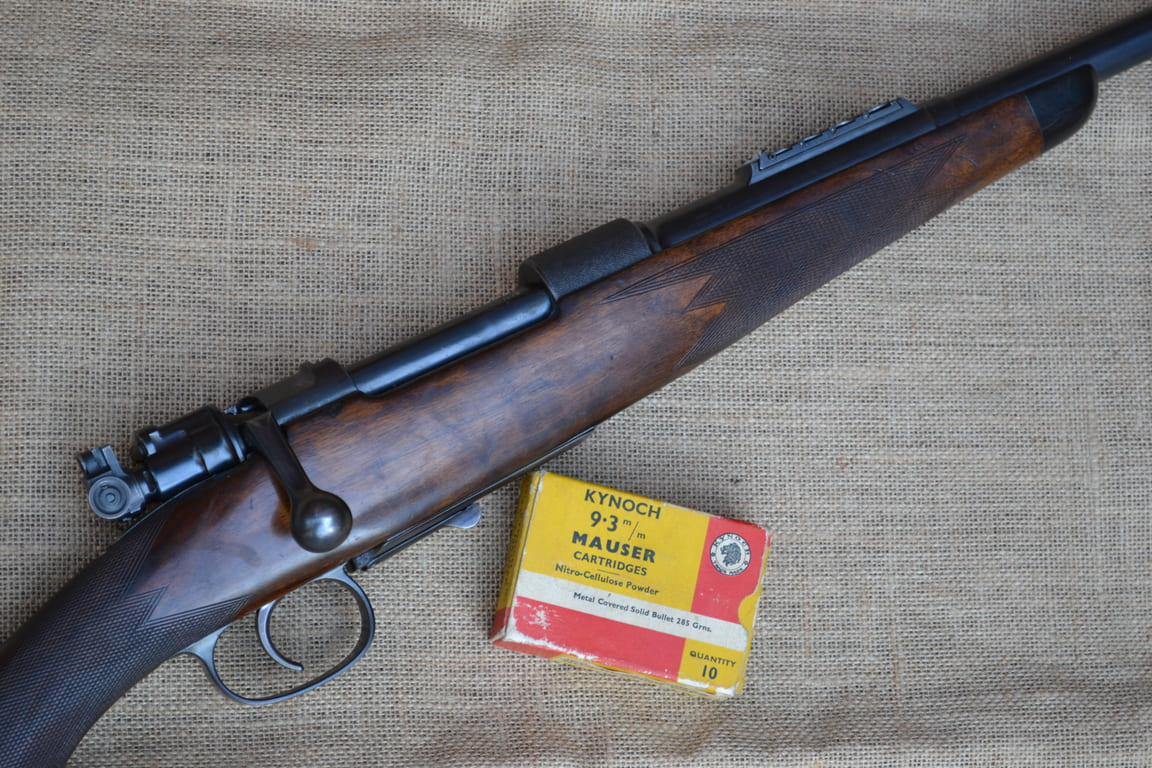
In 1894, after reaching the age of 65, John Rigby was forced to retire from government employment and returned to the family business. After his years at the Royal Small Arms Factory, Rigby was fully abreast of the latest developments in small arms, and he set about implementing these in the family business. Two of these developments would become almost synonymous with Rigby during just a few short years: the M98 Mauser action and smokeless propellant.
Peter Paul Mauser, the brilliant designer of a host of bolt-action rifles that would arm not only the troops of the Kaizer but also those of a certain overpromoted Austrian corporal a few years later, appointed Rigby as their sole agent in 1898. Rigby then quickly set about making sporting rifles on Mauser actions and exporting these across the British Empire.
As time went on and Rigby developed a range of its own cartridges for sporting use, it became apparent that a few changes were needed to the standard-length M98 Mauser action.
In 1899, Rigby introduced the .400/350 NE cartridge for use in double and single-shot rifles. The .400/350 NE cartridge was a long, bottlenecked and rimmed cartridge that fired a 310-grain bullet with excellent sectional density at 2 100 fps. It quickly gained an excellent reputation in Africa and India.
However, with the nascence of the bolt action, and the costs associated with producing double and single-shot rifles, plans were afoot to make the .400/350 NE work from a Mauser action.

The Bell Edition rifle is made according to WDM Bell’s specifications and has a flattened spoon-type bolt handle as well as a Mauser flag safety. The magazine is also engraved with WDM Bell’s initials.
Although a sound idea in practice, two problems were immediately apparent: the .400/350 was not only too long to work from a standard-length Mauser action but its rim complicated matters even further as it required a special sloped magazine box. Rigby dumped the problem in Mauser’s lap. They came up with the solution to lengthen the standard-length Mauser action by a quarter of an inch and adapt the extractor and magazine box design of the Siamese Mauser action especially for the .400/350. The newly developed action was called the Magnum Mauser action.
Around 1910, it was once again adapted for yet another Rigby development, the .416 Rigby cartridge. With the .416, the magazine box was changed once more, this time fitted with a dropped floorplate that could accommodate four of the hefty cartridges plus one in the chamber. The .416 Rigby undoubtedly is one of the most revered big-game cartridges of all time and is very much still with us today.
In terms of double rifles, Rigby certainly wasn’t lagging behind in new developments either. Around 1897, they adapted the .450 Black Powder Express cartridge with a beefed-up cartridge case, a jacketed 480-grain bullet and 70 grains of a then new propellant called cordite. Cordite was made from a mixture of gun cotton, nitrocellulose and nitroglycerine.
The new cartridge, called the .450 Nitro-Express, fired a 480-grain bullet at 2 100 fps for almost 5 000 ft/lbs of muzzle energy.
Prior to the Nitro age, the 8-bore rifle was considered proper elephant medicine. This rifle fired a 900-grain lead bullet at 1 500 fps and developed (you guessed it!) just about 5 000 ft/lbs of energy. However, the rifles themselves were heavy and cumbersome, and black powder had certain other disadvantages as well, especially early on a damp morning in thick bush.
What Rigby had done was to repackage the 8-bore in a handy (and deadly) package weighing in at about 10 lbs. The .450 NE very quickly became an industry standard in the British gun trade, and there were very few makers who did not chamber rifles for the .450 NE.
THE RISING BOLT ACTION
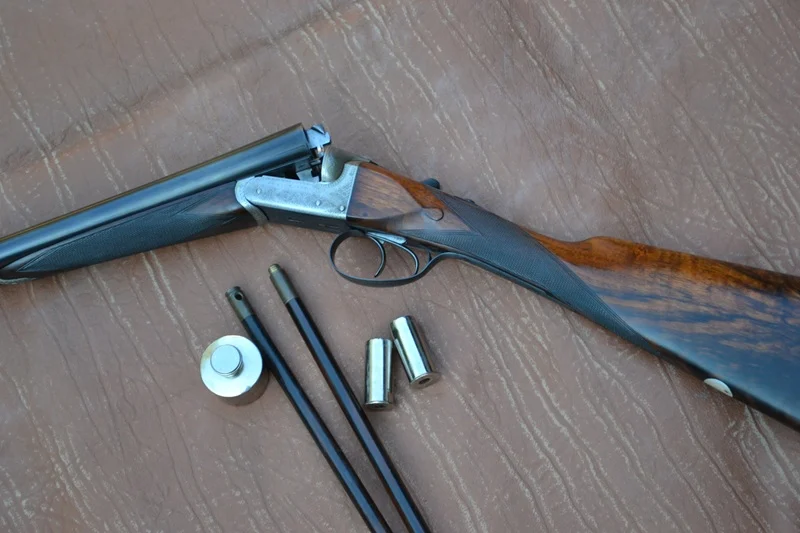
Rigby’s best-quality sidelock-actioned guns and rifles in the early Nitro era were made on an action that was patented in the names of both John Rigby and another gunmaker, Richard Bissell. The action used was a very unusual and intricate third fastener that would become known as the rising bolt action, more commonly (and wrongly) referred to as the “Rising Bite”.
In the book Rigby: A Grand Tradition (Rigby Press, 2012), the rising bolt is described thus:
“The rising bite differs substantially from other third fasteners in design, complexity, and sheer mass. The rib between the barrels extends into a stout U-shaped loop. When the gun is closed, this extension fits into a recess cut into the top of the break-off. There, the hollow of the loop is filled by two posts, the front one fixed and supporting the rear one, which slides up and down behind it.”
By 1912 or thereabouts, the rising bolt was on its way out, however. It was a very difficult and time-consuming action to make and file, and Rigby gradually started turning to another stalwart of British gunmaking, Webley & Scott, for actions for their double guns and rifles.
Thus, best-quality Rigby doubles were increasingly made on what is known as Webley screw-grip actions from roughly 1914 onwards until the outbreak of hostilities in September 1939. The screw-grip is rightly regarded by many as one of the finest double actions, so Rigby most certainly did not take a step backwards by quietly adopting the Webley screw-grip.
Boxlock-actioned Rigby double rifles (described in the old catalogues as Class “C” rifles) tended to be made on what Webley referred to as their PHV-1 action, known to the rest of the trade as a long-bar Webley action because of the lengthened action bar. As with the screw-grip, quality and hence longevity were superb, and many of these old rifles still soldier on in Africa and elsewhere.
POST-WORLD WAR II
World War II changed things irrevocably for the British gun trade, and Rigby was no exception. With the German economy bombed to smithereens and the Mauser factory destroyed by French occupation forces in 1947, the first and most obvious problem was sourcing Magnum Mauser actions for clients desiring rifles in .416 Rigby.
Taking apart rifles for their Magnum actions became commonplace, especially .350 Rigby Magnum (another Rigby proprietary cartridge introduced in 1912 that saw widespread use and was also made on the Magnum Mauser action).
In the early 1950s, the French-made Brevex Mauser action brought some relief, and Rigby made 50-odd .416s on this action before it, too, was no more. The Brevex was never made in large numbers and must have been tremendously expensive to manufacture.
Rigby came up with other solutions, such as to splice two standard-length M98 actions together to form one Magnum-length action, and even to build them on opened-up, standard-length M98s. However, it wasn’t until the late 1980s that newly manufactured Magnum-length M98 actions became available again. In the meantime, even the Brno 602 action was used on a number of Rigby .416s.
For double rifles, the situation must have been even direr, and production of best-quality, sidelock-ejector Rigby double rifles slowed to a trickle. Webley & Scott was hanging on by its fingernails, and with it, the supply of quality sidelock and boxlock actions, and barrelled actions.
By the early 1990s, Paul Roberts, owner of Rigby from 1984 to 1996, had made a number of sidelock double rifles in calibres up to .577 NE. By this time, however, the market had changed again, and these were almost exclusively made on a one-off basis for wealthy collectors. Some of these rifles do come up for sale every now and then, but as the saying goes, “If you have to ask the price, you can’t afford it!”

A side-on view of a Rigby Big Game Vintage Edition. The Vintage Edition is made along the lines of the famed pre-World War II .416 Rigby rifles.
DISASTER!
Due to a combination of circumstances that do not bear repeating here, the Rigby name was sold to a Texan businessman in 1997. He moved production to a small town in California and appointed a man with a background in manufacturing components for the aviation industry as his head gunmaker – let’s call him Mr X.
This latter individual, who also claimed extensive military experience, promptly set about making some Rigby double and magazine rifles that bore no resemblance whatsoever to any London-made Rigby.
Double rifles, both boxlock and sidelock, were made on 20-bore shotgun actions sourced from a well-known German manufacturer. Build quality was very much a hit-or-miss affair, and California Rigbys became known for racy American styling instead of the austere and elegant British styling that made Rigby what it was in the first place. California-made Rigby bolt-action rifles did not fare any better, either.
Although various grandiose claims were made for the California-manufactured Rigbys, the party eventually ended abruptly when it came to light that Mr X had not only lied about his alleged previous military experience (a criminal offence in the USA), but that the company had to file for bankruptcy as well. It was a sad end, but luckily, all was not lost.
A group of investors bought the Rigby name in 2013 and sold it to the L&O Group from Germany in 2014. The L&O Group owns some of the better-known names in gunmaking, such as JP Sauer & Sohn, Blaser and Mauser, and it set about injecting money into resurrecting Rigby.
In a wise move, Marc Newton was appointed as managing director. Marc, who had started his career in the British gun trade under Paul Roberts, is passionate about all things connected to British gunmaking and Rigby in particular. In no time, Rigby was up and running again, this time from London premises like before.
CURRENT PRODUCTION
As of this time, Rigby is in full production with a series of factory-produced bolt-action rifles that caters for virtually every need.
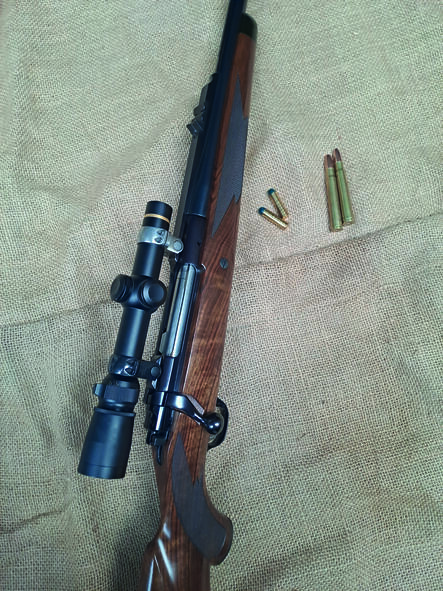
As the name implies, the Big Game is available in .375 H&H, .416 Rigby and .450 Rigby, and it is made from barrelled actions sourced directly from the Mauser factory.
The Highland Stalker is a light-calibre rifle intended for hunting in terrain where it will not only be subjected to serious use but also a lot of carrying. It is available in .275 Rigby (7×57), .308 Winchester, .30-06 Springfield, .300 Winchester Magnum and 8×57 JS. A host of custom options are available for the Big Game as well as the Highland Stalker.
To uphold Rigby’s reputation as a maker of best guns, the London Best bolt action is also available. Unlike the other models, the London Best is a fully bespoke rifle, and Rigby produces it according to the customer’s personal taste. It is available in a host of calibres, from small to large, and the sky is literally the limit with the London Best.

A close-up view of the very intricate Rigby Rising Bite (or rising bolt) action in the open position. PHOTO: JOHAN VAN WYK
As for double rifles, another Rigby speciality, the Rising Bite, is in production again. Though production is limited, new Rising Bite rifles are spoken for many years in advance.
The resurrection of the Rising Bite was made possible by the tremendous advances made in computer-aided design and manufacturing techniques during the past decade or so. Although the modern Rising Bite may be superficially similar to the vintage rifles that left Rigby’s workshop more than a century ago, it is stronger and made to very exacting tolerances. The Rising Bite is available in calibres up to and including the mighty .600 NE.
Although Rigby was never known as a maker of shotguns, it produced a fair number of very fine shotguns over the years. New Rigby shotguns are in production today again on a revised Rising Bite action (the bar of the Rising Bite shotgun action is shorter as there is no need to cope with the same pressure levels as that generated by double rifles) from .410- to 12-bore.
During the past few years, Rigby has become known for its limited-edition rifles, which it calls the Heritage Series. The latest edition of the Heritage Series to see the light is the Bell Edition – a .275 made to the specifications of the sixth and last .275 Rigby, ordered by the legendary WDM Bell in 1928.
The magazine floorplate is engraved with Bell’s initials, and the action has a flat bolt handle and a traditional Mauser flag safety. The rifle is presented in a limited-edition canvas case with a Rigby knife, cleaning rod and other accessories, as well as a copy of the ledger entry for Bell’s rifle, signed by Marc Newton.
The Bell Edition rifles are a proper tribute to one of Africa’s legendary hunters. With production limited to just 50 rifles, the Bell Edition is sure to find favour with a handful of purists and collectors the world over.

THE RIGBY LEGACY
From an African and Indian perspective, Rigby is first and foremost known as a maker of some of the finest hunting rifles ever produced. Traditionally, Rigby’s clients included the cream of Indian nobility during days gone by, and many an African hunter stared into the jaws of death, armed with a Rigby double or magazine rifle.
The rifles themselves had unique styling that set them apart from the products of some of the other fine makers of the time. Vintage Rigby bolt actions were styled in a very austere way without a cheekpiece, gold oval or fore-end tip. They have been described as elegantly simple with nothing that you can take away, yet nothing that you would want to add, either.
Vintage Rigby double rifles also had a very distinctive look about them. A Rising Bite is instantly recognisable, not only for the third fastener but also for the very distinctive dipped-edge lockplates.
Rigby rifles have seen service in the hands of famous hunters such as Jim Corbett, WDM Bell and JA Hunter. Without fail, they have been mentioned in books and other writings over the years, not only for their beauty but also for unstinting reliability. The products manufactured by the Rigby of today are made in the same vein – by hunters, for hunters!
Rigby rifles and other products are exclusively sold in South Africa by Safari Outdoor. Contact them via the web at www.safarioutdoor.co.za.